
Greetings from the edge,
I love dungeons. They are, after all, at least 50% of the game. They are neat, self-contained little slices of your world that can be as flavourful, strange, or dripping with lore as the grandest city or most lavish court. At their very best, they become complex ecosystems, complete with hierarchies, routines, and very good reasons for being there.
But here’s a quiet truth about most dungeons: we’ve been running them wrong since the early ’90s.
They don’t do anything unless the players poke them.
Rooms sit. Monsters wait politely. Torches burn. Dust hangs in the air. It’s less ancient deathtrap and more slightly dusty museum with attitude.
Dungeon turns fix that.
What Are Dungeon Turns?
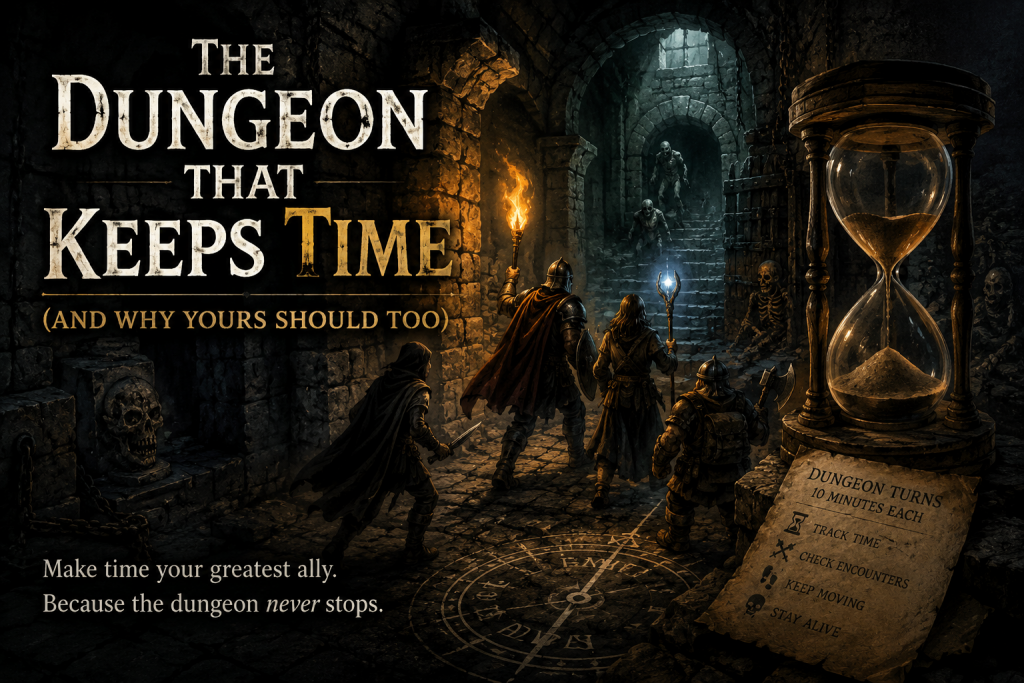
Essentially, dungeon turns break exploration down into ten-minute chunks of in-game time that are used to resolve meaningful actions. Almost everything the party attempts inside the dungeon consumes a turn. Things like:
- Searching a room
- Checking for traps
- Picking a lock
- Filling out a map
- Search a defeated foe
- Forcing open a stubborn door
- Arguing about which way to go (yes, really)
Time stops being abstract and starts becoming measurable.
And once time is measurable, you can track it, pressure it, and make it matter.
Why This Changes Everything
Once time becomes measurable, you can start spending it like any other resource.
Every dungeon turn can trigger things like:
- Wandering monsters
- Patrols doubling back
- Torches burning low
- Spells or buffs expiring at deeply inconvenient moments
And remember: the dungeon is not just where its inhabitants sleep.
It’s where they live. Eat. Pray. Scheme. Hide bodies. Relax with a bottle of something highly questionable.
Add a few random events into the mix, and suddenly the dungeon is no longer standing still.
It becomes a reactive environment, a living ecosystem that keeps moving whether the players are ready or not.
Add a Little Pressure
Dungeon turns give you all sorts of ways to turn the screws. You can add simple tension mechanics such as:
- Each turn, add a die to a pool
- When the pool fills, roll the dice
- Something happens
And it’s not always combat. Some of the best tension comes from uncertainty:
- A distant scream
- Footsteps getting closer
- A non-combat monster walks in (Cue Boblin the Goblin Cook)
- A door that was open… now isn’t
- Torchlight flickering somewhere deeper in the dungeon
The dungeon, or at least its denizens, starts to feel aware of the party.
Dungeon turns also help solve the dreaded skill dogpile problem, where one player rolls badly and suddenly the entire party forms an orderly queue to inspect the same suspicious flagstone.
If checking for traps takes ten minutes, and wandering monsters are a very real possibility, players become far less likely to spend an hour conducting a six-person archaeological survey of one corridor.
It also encourages players to lean into what their characters are actually good at and work together more creatively. If the rogue fails to pick the lock, there is always the barbarian’s preferred method:
The large skeleton key attached to the end of their leg.
What This Actually Does
In a game where heroes can wield magical weapons that make Excalibur look like a butter knife and summon creatures that would give H. R. Giger nightmares, realism is already a fairly silly concept.
This isn’t about realism.
It’s about impetus.
Used well, dungeon turns encourage players to start thinking more like their characters, which is the heart of roleplaying after all. Add even a small amount of pressure, and players stop dithering, stop skill dog-piling every failed roll, and start making decisions with actual urgency.
After all, that five-second dice roll might represent ten dangerous minutes in the dungeon.
The result is:
- Faster decisions
- Less out-of-character meta-gaming
- More teamwork
- A constant sense that something may be moving in the dark beyond the torchlight
And perhaps most importantly, players begin to feel hunted.
Even when they aren’t… yet.
If you use dungeon turns correctly, you don’t need to push the party forward.
Time does it for you.
So, what does all this mean?
Next time your players venture into a vault, tomb, or abandoned temple dedicated to some long-forgotten god, try this:
- Track time in 10-minute turns
- Every 2–3 turns, roll for an encounter or event
- Keep a visible count somewhere at the table (a notepad works perfectly well)
Don’t explain it too much.
Just quietly roll the dice, or if you’re feeling particularly diabolical, ask a random player to roll for you.
Then let them feel it.
A good dungeon isn’t just a place.
It’s a process. A living ecosystem where the players may not actually be the apex predators.
And once time starts moving, your subterranean halls stop being somewhere the party simply breezes through and start becoming somewhere they genuinely explore.
Because the greatest weapon a dungeon possesses is not darkness, monsters, or traps.
It’s the clock ticking somewhere behind the walls.
See you in the margins,

Leave a Reply