Greetings from the edge,
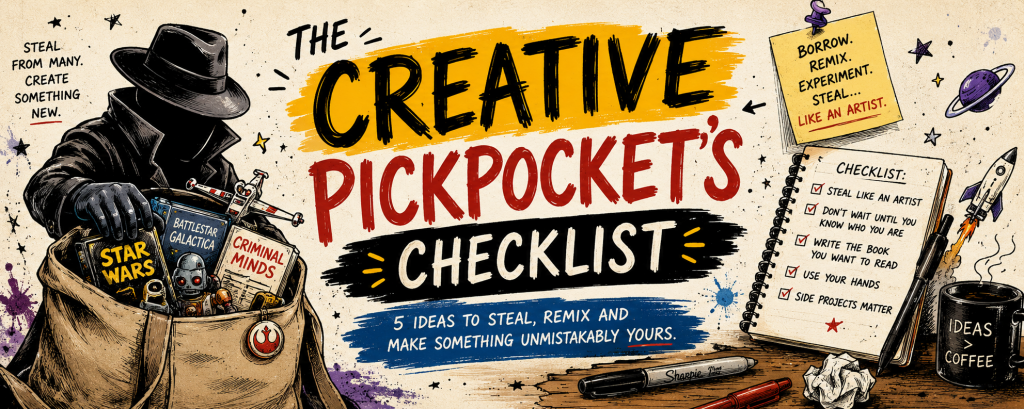
Austin Kleon has made a pretty decent living out of encouraging not so much art theft as a kind of creative burglary spree, where we steal a little from Star Wars, a little from Battlestar Galactica and a pinch of Criminal Minds, throw them into a blender and make delicious cookies about space magicians shepherding the last remnants of humanity while solving crimes aboard a migrant fleet.
Every creator is influenced by other people, ideas, TV shows, movies and just about every single thing that they come into contact with. The goal is not to create from absolute nothingness. The goal is to collect influences, understand them, and turn them into something that carries your own fingerprints.
The book is built around ten main ideas. Today, I will be looking at the first five.
Steal like an artist
To put it one way: ain’t nothin’ come from nowhere, nohow. To put it in a way that won’t make my spellchecker need to call its therapist: Everything comes from somewhere.
Study the work of people whose work lights a fire in you, excites you, and ask yourself, ‘What exactly is it that makes this so good?’ Don’t be a human photocopier; anyone can rewrite Star Wars with slightly different wallpaper and substantially less Jar Jar, but an artist puts elements from dozens of sources in a blender and makes a delicious smoothie of brand new ideas.
Don’t just steal from one person. Be an equal opportunity larcenist. Smash ideas together like a toddler with Tonka trucks and see what survives the collision.
Don’t wait until you know who you are
If every artist had waited until they knew exactly who they were before picking up a brush or touching a keyboard, we would have no works of art at all. Think of mini-you back in kindergarten, just mashing colours and shapes together. Did they have any clue what they stood for? Other than dinosaurs being awesome and Brussels sprouts being an affront to civilisation?
The fact is, if you wait until you know exactly who you are, not only will you spend your life staring at a blank page, but you’re effectively trying to open a box with a crowbar that’s trapped inside the box.
First you create, then you grow.
Action comes first. Reaction follows.
Write the book you want to read
When you sit in your comfy creative’s chair, whether that’s a beanbag in the laundry room (à la early Stephen King), a walnut writing desk that bears absolutely no relationship to a raven, or a broom cupboard packed with more tech than NASA, like yours truly, don’t write for anyone except yourself.
I know that sounds like oddly selfish advice, but allow me to elucidate: once ensconced in your creative bubble, you should create the thing you wish had existed to inspire you in the first place.
When I wrote Cabin Fever (coming soon to the short fiction section), what I was really in the mood for was zombies in space. There are a few stories like that already, but I wanted one with genuinely likeable characters who felt like they would happily drink at the same bar as the crew of Serenity.
Such a story, to the best of my knowledge, didn’t exist…
Until it did.
If it doesn’t exist yet, but you want it to, maybe that’s the universe gently shoving you toward being the first person to make it.
Use your hands
Your brain is a remarkable engine of creation. The unique layout of neurons and synapses inside your head makes you a one-of-a-kind creative machine.
And by your brain, I really mean you. Yes, you, reading these words right now. Only you can create your masterpiece. Only your mind is wired exactly the way it is, carrying your experiences, influences, strange obsessions and favourite stories around like luggage.
I say this as a writer whose handwriting is so atrocious that only a codebreaker from Bletchley Park could decipher it, but you still need to work with your hands. Don’t rely too heavily on screens. Use markers and paper notebooks, doodle ideas in margins, or at the very least print out your work if only so you have something physical to launch across the room when the SPAG gremlins begin breeding.
The act of physically creating things lights up different corners of your mind, and if you want to be creative, you’re going to want all hands on deck.
Side projects matter
The Simpsons has been on television since December 1989 and has survived decades of good episodes, questionable episodes, a feature film, approximately seventeen billion memes and enough merchandise to fill a small moon. It also began life as what was essentially a side project.
The short version goes something like this: Matt Groening was already finding success with his comic strip Life in Hell. When The Tracy Ullman Show approached him about adapting it into animation, he didn’t want to hand over his beloved intellectual property. So, in a panic and with little time to think, he sketched out a strange yellow family in about fifteen minutes.
Then… bam. Pop culture changed forever.
Charles Dickens wrote A Christmas Carol in just six weeks because the financial wolves were circling and he desperately needed a pay cheque. More than 180 years later, it remains part of many people’s Christmas rituals.
The point is that sometimes the strange, odd and seemingly silly little side projects end up becoming more important than the work we once considered our “serious” projects.
Austin Kleon has done more than hand creators a blueprint for escaping creative paralysis. He has given us permission to stop obsessing over originality and start making things. To do what artists have always done: borrow, remix, experiment and steal… like an artist.
See you in the margins,
Leave a Reply