Greetings from the edge,
I’ve spent the weekend slowly melting into a puddle while wearing an offensively loud shirt.
Friday’s post pulled in a lot of eyeballs and, on the strength of that, I return bearing Part 2 of my smash-and-grab raid into Austin Kleon’s masterclass in creative larceny: Steal Like an Artist.
Here are my takes on the final five of Kleon’s golden rules.
Secret work and hobbies have value
Back in the mid-90s, I was heavily into science fiction and came across a book in my school library. It was a collection of photographs from the Golden Demon miniature painting competition, and it absolutely blew my tiny mind.
This was a pre-Internet era, back when we were all still impressed that Encyclopaedia Britannica could fit onto a CD. Yes, yes, I am aware of how ancient that makes me sound.
I rang around toy shops, then specialist hobby stores and eventually found Games Workshop.
But that was only the beginning.
From there, I discovered D&D, and by the late 90s, I was neck-deep in The Forgotten Realms, GURPS supers, and Call of Cthulhu.
To this day, I still love roleplaying and, although my miniature painting skills remain somewhere between “questionable” and “active threat to tiny plastic people”, that accidental side project led me toward a lifelong passion.
Like night follows day, and like hangovers follow tequila, writing eventually followed roleplaying.
Years later, after randomly stumbling across a funny little book about painting miniatures, here I am trying to carve out a life as a writer.
You don’t need every activity to become content or income.
Hobbies feed creativity in strange ways.
Geography isn’t everything anymore
You are not alone.
No matter how remote you are, or how niche your interests happen to be, if you have access to the internet and can operate Google with even a modest degree of proficiency, there are communities out there waiting for you.
Clever artists have places like DeviantArt, writers have Scribophile, and there are entire little digital villages built around every obscure hobby and passion imaginable.
From Reddit communities swapping painting techniques to weird little blogs acting as your own personal cheerleader squad, you no longer have to move to some mythical artistic Mecca to find fellow creators and an audience for your work.
No matter whether you’re tucked away in the Outer Hebrides or sitting in downtown Copenhagen, if you’ve got the urge to create, an internet connection and the courage to put your work out there…
…you are not alone.
Be nice and join the scene
“There’s only one rule I know of: you’ve got to be kind.”
Kurt Vonnegut
Vonnegut’s advice feels even more relevant in today’s hyperconnected information ecosystem. It is absurdly easy to find yourself in a Twitter beef with a complete stranger that you’ve never met and almost certainly never will.
I’m fairly sure we’ve all done it at some point. From that prick on Reddit to the misogynist in YouTube comments, to Twitter itself, the ancient grandfather of online shouting matches, we’ve all wasted precious time and energy trying to school somebody.
Don’t.
Enough already.
Does it really matter that FlagFist1776 thinks your metaphors are trite? Especially when you’ve got a dozen positive comments sitting right beside it?
Don’t feed trolls. Thank them politely for the engagement if you feel inclined, then move on with your life.
Creativity is, at least in part, a social act. Support other creators in your circle and participate in communities where people can share ideas.
Don’t be the goblin sitting atop a mountain of ideas like creative Smaug.
What’s the point if you never share the treasure?
The best way to defeat an enemy on the internet is usually to ignore them. The best way to make a friend is to follow their work and leave positive, useful feedback.
When you get positive feedback yourself, keep it. Make a folder for it. Read criticism and keep anything useful, but if somebody is just hurling rotten tomatoes from the cheap seats, throw it in the bin.
Don’t wallow in old praise, but every now and then, remind yourself that people liked what you made.
Be Boring
There was supposedly a time when being an artist meant drugs, parties and enough chaotic excess to keep several tabloid newspapers in business for a decade.
The funny thing is that those mythical “golden days” are always somewhere in the past. In the 2000s people talked about the 80s. In the 80s they talked about the 60s. In the 60s they were probably looking wistfully at somebody drinking absinthe in the 1920s.
You always miss it by about two decades and a gnat’s wing.
And now?
Now there’s work. Lots and lots of work.
Create a sustainable routine. One you can actually stick to without ending up burned out, skint, hungover or otherwise operating with half your brain missing.
Forget the archetype of the artist as a permanently wild hell-raiser. Think of creativity less like divine lightning striking a mountaintop and more like a job that occasionally lets you wear pyjamas.
Every artist probably goes through a phase of believing that chaos and creativity are secretly best friends, but in the long term, they make terrible housemates.
Look at Stephen King. He has spoken very openly about his struggles with drugs and alcohol during parts of his career. Despite producing enormous amounts of work, he has also said he barely remembers writing some books from that period.
Talent gets you started.
Routine keeps the engine running.
Creativity is subtraction
Dr. Seuss wrote The Cat in the Hat using a carefully controlled list of just 236 words. His editor later bet him that he couldn’t write a book using only fifty.
He accepted the challenge and eventually produced Green Eggs and Ham.
The damn thing went on to become one of the best-selling children’s books of all time.
Unsane, a 2018 horror film, was shot entirely on iPhones with a relatively modest budget and still pulled in many times its cost at the box office.
Less can often become more.
Constraints and limitations sharpen ideas rather than suffocate them.
The big thread stitching all of this together is:
“Stop worrying about being perfectly original and start making things.”
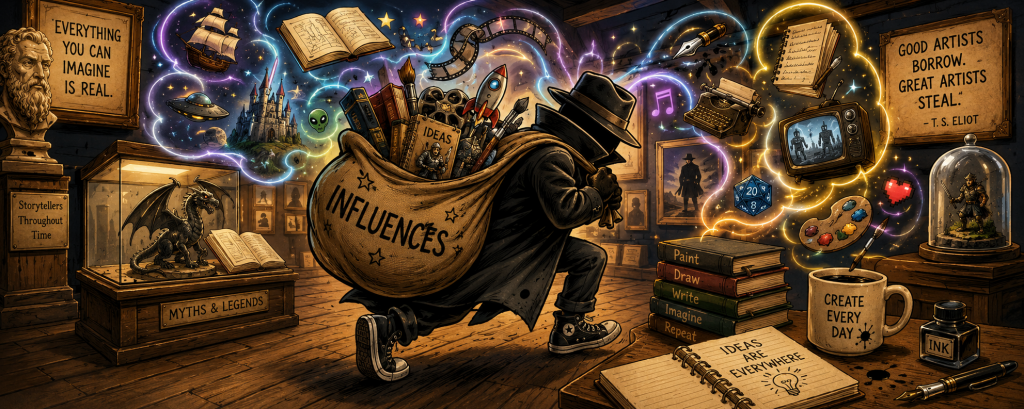
No artist or creator emerges from a vacuum. Forgotten Realms borrowed from Tolkien, who in turn borrowed from mythology. Those myths themselves were echoes of much older stories told around campfires, and perhaps those stories started with somebody waking up from a strange dream after seeing something odd in the woods.
That’s thousands of years separating a weird old man in the forest and Elminster of Shadowdale.
The point is that limits force us to knuckle down and create.
Read widely.
Watch strange films.
Play games.
Borrow techniques.
Learn from everyone.
Then lock it all away in your brain cupboard and see what strange creatures eventually crawl back out.
See you in the margins,
RBD
Leave a Reply