
More Than Pea Soup: Why The Exorcist Still Works
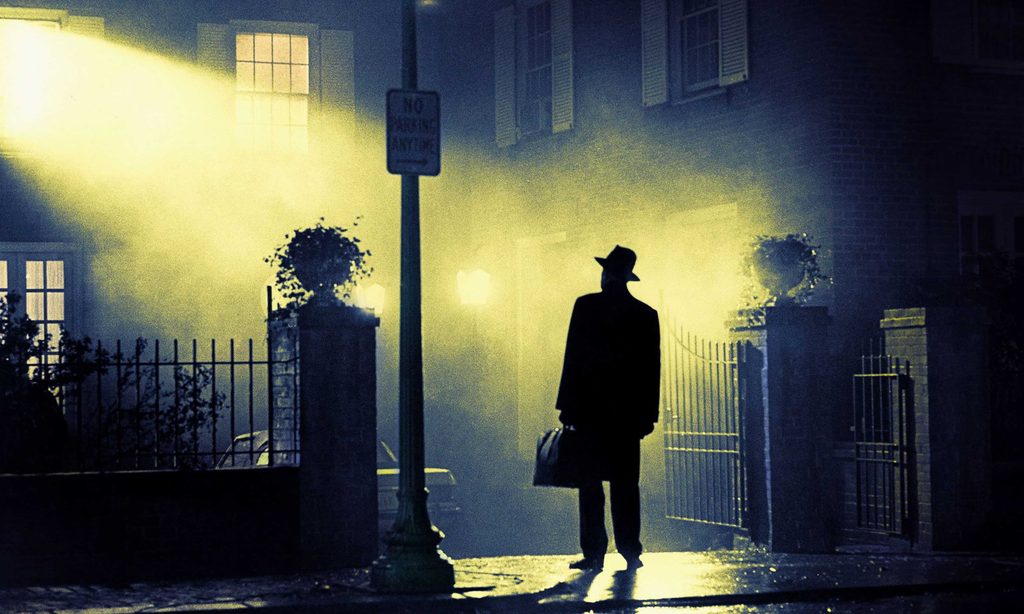
In 1971, we were introduced to Pazuzu. Although no one ever says the name aloud in The Exorcist, he left an indelible mark on horror; from parodies to homages to outright retellings, William Peter Blatty’s demon has haunted cinema and literature for more than 50 years.
You can see his infernal fingerprints everywhere.
Put a possessed youngster in a bedroom, bring in a priest carrying a battered leather case and a crisis of faith, have the furniture start moving, and sooner or later, the shadow of The Exorcist falls across the room. Even stories that deliberately reject Blatty’s Catholic framework still find themselves having a conversation with it. Paul Tremblay’s A Head Full of Ghosts, for example, doesn’t simply tell another possession story; it plays with an audience that already knows what a possession story is supposed to look like. The Last Exorcism gives us a deliciously corny preacher who, despite having lost his faith, still offers his services as an exorcist and keeps us guessing if it is real until the very end. (Spoiler: Cotton picked a really bad day to rediscover his faith.)
We know the shape of it all because The Exorcist taught us.
That is a remarkable legacy for a novel published more than half a century ago, and an even more remarkable one for a film released in 1973. The seventies were hardly short of competition, either. Horror was undergoing one of its periodic mutations, giving us The Texas Chain Saw Massacre, Carrie, Halloween and, right at the decade’s end, Alien. So it says something that The Exorcist didn’t simply survive among them; it still resonates today.
Even though horror has become bloodier, louder and considerably less concerned about upsetting the neighbours (I’m looking at you, Terrifier, you sick puppy), The Exorcist has never quite gone away.
Perhaps that is because beneath the pea soup, obscenity, spinning heads and fifty years of parody, Blatty’s story was never really about a little girl behaving horribly in a bedroom.
It was about faith. Doubt. Guilt. Parenthood. Suffering. The possibility of evil.
And, perhaps most importantly, what we are prepared to sacrifice when somebody we love is trapped in the dark.
So, more than fifty years later, why does The Exorcist still work?
Funny you should ask; I have written an article about that very subject.

It Gave Possession Horror Its Grammar
Although The Exorcist didn’t invent recreational demonic possession, it certainly wasn’t the first novel to tackle it. Depending on how far back you want to go, you could point to Ray Russell’s The Case Against Satan (1962), or even Robert Hugh Benson’s The Necromancers (1909). What Blatty did was give modern possession horror its extremely recognisable form.
The ingredients for possession horror have been around as long as possession legends, but Blatty found the exact blend to turn them into something like a template.
Certain definable, distinguishing factors set possession horror apart from, say, a ghost film, a zombie flick, or whatever the hell Videodrome is.
You typically have: an ordinary household, a vulnerable young victim, sudden and unexplained behavioural changes, a search for a medical or scientific answer that inevitably fails, a family coming under strain and turning, somewhat reluctantly, to a religious figure. Normally, but not always, that figure is Christian. For a Jewish example, see The Possession (2012).
From there, things escalate from odd to blasphemous and obscene, all building towards some form of ritual confrontation.
Put those elements together, and you have a demonic possession movie.
A key part of the possession-horror mythos is scepticism. In The Exorcist and many of its successors, Chris MacNeil doesn’t jump up and start shouting ‘Demon!’ like a 17th-century Puritan. She gets doctors to investigate, and even Karras doubts.
The paranormal has to fight its way onto the screen and off of the page.
It’s a pattern that survives in The Exorcism of Emily Rose, The Last Exorcism, The Taking of Deborah Logan and A Head Full of Ghosts. All of them know that possession becomes more convincing when the story itself tries very hard not to believe in it.
“The paranormal has to fight its way onto the screen and off of the page.”
In The Exorcism of Emily Rose, the film moves the science-vs-faith argument into the courtroom. The Last Exorcism explicitly presents its preacher as a fraud, a con man and a sceptic. The Taking of Deborah Logan flips the script, swapping the possessed child for an elderly woman living with dementia. A Head Full of Ghosts makes our familiarity with the possession genre part of the machinery.
Same sentence structure, different vocabulary.
We all know what happens next when we see a priest approaching a bedroom with a case.
We don’t need anyone to explain what the case contains or why he’s there.
We’re going to get someone talking in two voices at once, and the bedroom is going to become a battleground. Even in the countless parodies made over the years, it all depends on the audience knowing the shorthand.
The Exorcist has been copied, inverted, modernised and reinterpreted through different religions. Its assumptions have been questioned, rejected and openly mocked.
But we’re still speaking its language.
Blatty didn’t invent possession horror.
He gave it a grammar.
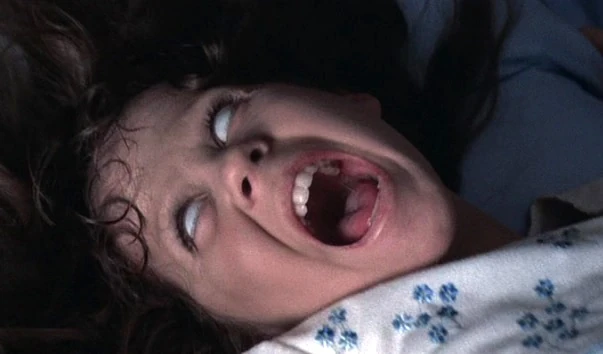
It made the Supernatural Credible by taking scepticism seriously.
The Exorcist doesn’t ask us to take the existence of a demon as read; far from it. We are standing right there alongside the characters, ticking off the logical, rational explanations for Regan’s ‘condition’ until we’re practically shouting for holy water and a good, battered Bible.
First, we have Chris MacNeil.
Chris isn’t religious, particularly credulous or looking for a paranormal explanation. Quite the contrary, in fact. At first, all she knows is that something is happening to her daughter, so she does what any moderately sensible modern parent would do: she goes to the doctors. Then specialists.
Tests. More doctors. More tests. Psychiatry.
Chris naturally wants an explanation that calls for chlorpromazine rather than holy water.
At the start of The Exorcist, we’re thinking: “There has to be an explanation for this.”
Then: “Okay, that’s weird.”
Then: “That shouldn’t be possible.”
Then: “That is definitely not possible.”
And eventually: “Right. Someone get a priest.”
And when the priest, Father Karras, arrives, it isn’t in a tricked-out Popemobile and a cloud of tyre smoke, jaw grimly set for a fight to the death against the Devil’s own squatters.
Instead, Blatty gives us a very clever sceptic.
Karras is not only a priest, but also a psychiatrist and, more importantly, his own faith is already falling apart like a skyscraper made of cake and stale Pringles.
So, when Chris is at the end of her tether and decides the answer may indeed be Satan, the priest she gets essentially nods sympathetically, sucks air through his teeth and says:
“Have you considered that it might not be?”
Dramatically speaking, that is wonderful.
Chris has finally fought her way through medicine far enough to entertain the possibility of demonic possession, turns to the Catholic Church for help, and the Church effectively sends her another bloody psychiatrist.
A lesser horror story would have presented Karras as The Guy Who Knows What Is Happening™ and left it at that. Blatty had other ideas.
At the beginning, Karras is another obstacle to accepting the supernatural.
He doubts Regan is possessed.
He doubts himself.
He doubts his vocation.
He is, quite literally, a priest struggling to believe.
So much so that the demon has to convince him as well.
The Church itself is never presented as some unholy cross between the psychic hotline and Ghostbusters. Nobody hears the word ‘possession’, slams a big red button marked EXORCIST and dispatches a priest with sirens blazing.
There are procedures; there is bureaucracy.
They have to gather and assess evidence. Alternative explanations must be considered. The possibility of mental or physical illness must be explored before anybody even thinks about calling in the spiritual goon squad.
That institutional scepticism matters.
If even the organisation that supposedly believes in demons wants to exhaust every mundane explanation before declaring one present, then when the Church finally accepts that an exorcism may be necessary, the audience has been given permission to accept it too.
The ritual becomes frightening precisely because everybody involved would rather it wasn’t necessary.
Medicine Doesn’t Have to Be Stupid for the Supernatural to Be Real
This is another place where The Exorcist succeeds where lesser supernatural horror sometimes falls flat.
The doctors aren’t idiots.
They aren’t arrogant men in white coats wandering around sneering at the audience because they haven’t noticed the enormous demon standing behind them.
Their explanations are reasonable.
Their tests make sense.
They treat Regan according to the evidence they have.
The film doesn’t need medicine to fail because medicine is incompetent. It simply reaches a point where medicine can no longer adequately explain what is happening.
Science isn’t defeated in The Exorcist. It simply runs out of road.
That distinction is enormously important.
Every rational explanation that disappears leaves us with fewer places to hide.
Neurological? Maybe.
Psychiatric? Possibly.
Trauma? Worth investigating.
Fraud? Increasingly as difficult to believe as a politician’s promise.
Demonic possession? Well…Shit.
And William Friedkin reinforces all of this by shooting much of The Exorcist with an almost mundane realism.
Chris’s house feels like a real home rather than a haunted-house set. Georgetown is busy, ordinary and inhabited. Karras rides the subway. People drink coffee, argue, work, go to hospitals and sit beneath fluorescent lights waiting for test results.
Some of the medical sequences are uncomfortable precisely because they feel so clinical and real.
For long stretches, The Exorcist behaves less like a Gothic horror film than a domestic drama about a desperately sick child and a mother who cannot find anyone capable of helping her.
Then something impossible enters that world.
Pazuzu doesn’t haunt a crumbling castle somewhere in the Carpathians; He invades a bedroom in Georgetown.
And because everything around that bedroom has been presented with such stubborn normality, the supernatural feels less like something from a horror story and more like an intrusion into ours.
That is perhaps The Exorcist’s cleverest trick.
It never begins by asking us to believe in Pazuzu.
It gives us medicine. Psychology. Doubt. Institutional caution. Every sensible explanation we might reach for.
And then, one by one, it takes them away.
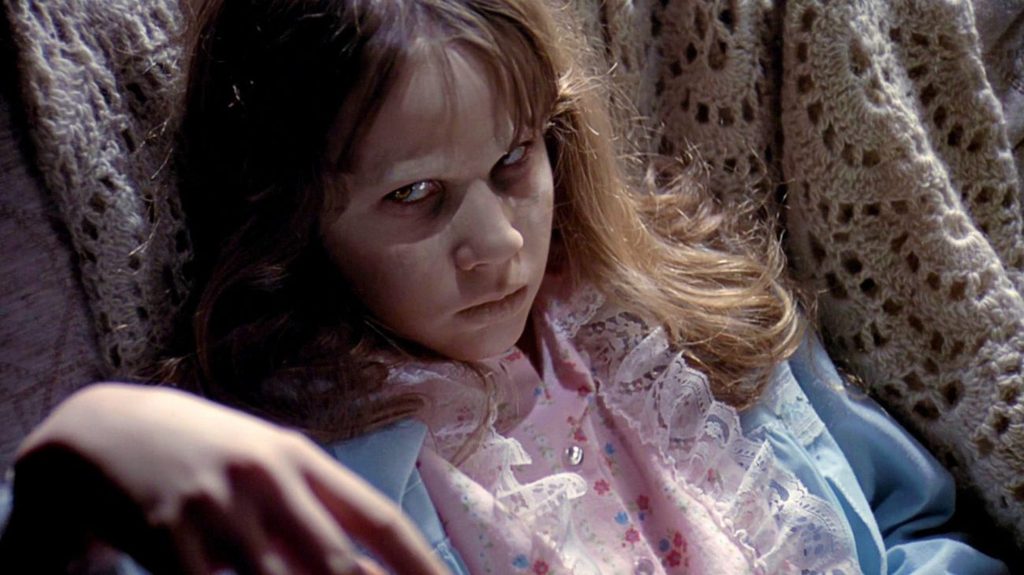
Regan Is a Person Before She Becomes a Horror Icon.
Linda Blair went from being a young actress to horror movie royalty with a barnstorming performance as Regan, a turn that earned her a Golden Globe and a nomination for the Academy Award for Best Supporting Actress, as well as a VIP position in my nightmares.
But the irony is that, before she morphs into a pant-wetting avatar of pure terror, Regan is just a 12-year-old girl.
She plays. She is affectionate with her mother and receives affection in return. She is playful. Curious. Creative. She draws and makes things. She has childish conversations. She discovers the Ouija board and talks about Captain Howdy with precisely the sort of innocent enthusiasm that makes us immediately think:
Regan. Mate. Put the fucking board down.
What she isn’t is Damien Thorn in pigtails.
She isn’t introduced to sinister Latin chanting and ominous low-angle shots of her staring soullessly out of a window with eyes that could pierce a soul at twenty paces.
She’s just a kid.
Regan doesn’t know she is in a horror story. Captain Howdy isn’t an omen to her. He’s a playmate. We recognise the danger because we know what kind of story we’re watching.
She doesn’t.
Then she finds out.
And as she does, it’s horrifying.
Blatty and Friedkin spend time establishing that Regan has a personality completely independent of what eventually happens to her.
Pazuzu doesn’t only create a frightening child. He destroys a perfectly ordinary one.
Which is much nastier.
“Chris can see her daughter. She just can’t reach her.”
Her relationship with Chris is a cornerstone of the story, and in some of the film’s quietest, most haunting moments, Chris has to bear witness to the thing inhabiting her beloved daughter.
Still Regan’s face.
Still Regan’s body.
Sometimes even Regan’s voice.
But Regan seems to be gone.
Say hello to the new tenant.
Suddenly, possession becomes a particularly vicious form of horror because it attacks something fundamental about human relationships.
Chris can see her daughter.
She just can’t reach her.
And the really horrible possibility is that Regan hasn’t gone anywhere at all.
She may still be in there.
The thing is, as glib as I was about the new tenant, Pazuzu doesn’t merely use Regan as a fleshy Airbnb.
He weaponises her.
He uses her own body against her, makes her say things she would never say and turns her relationships into vulnerabilities. Her innocence is contaminated with obscenity and violence.
That’s a huge part of why the film’s most infamous scenes were, and remain, so upsetting.
The obscenity isn’t frightening because we’re all terribly straight-laced about using no-no words. It is frightening because the obscenity violates the personality we have already been introduced to.
We know who those words are coming out of.
Or, perhaps more accurately: we know who they aren’t coming from.
When the infernal shit hits the ecclesiastical fan, and the body horror really begins, Regan’s previously innocent face becomes marred with running sores and lacerations, her childish form contorting into impossible positions as Pazuzu treats the poor girl’s body almost as a prop it can use to torment everyone around it.
And underneath it all, theoretically, a twelve-year-old girl is still trapped somewhere inside.
The bone chiller here isn’t that Regan becomes hideous. She’s not Seth Brundle in a flannel nightie.
It’s that the real Regan may still be in there while something inhuman wears her face.
This is where Linda Blair really earns her silverware.
Her performance sells the carefree, affectionate little girl who thinks she is playing harmless games with an Ouija board before that identity is buried beneath something monstrous.
And possessed Regan ultimately becomes a collaborative creation: Blair’s physical performance, Dick Smith’s makeup, Mercedes McCambridge’s extraordinary voice work, and Eileen Dietz’s doubling all combine to create the horror icon we remember.
But that icon is built on top of Linda Blair’s ordinary Regan.
We’ve spent fifty years remembering the face in the bed.
But that face only frightens us because Blatty and Friedkin first introduced us to the girl underneath it.
The Exorcist could have given us a creepy child and waited for the demon to emerge.
Instead, it gave us Regan.
Then it took her away.

No One Has to Take Idiot Pills for the Horror to Work.
Horror as a genre has a long and proud tradition of 90% of the cast taking medical-grade Idiot Pills. People ignore blood on the ceiling; they go into basements alone when they absolutely should have only gone down there with a SWAT team; they generally act like they have left all sense of self-preservation in their other jacket.
The Exorcist doesn’t.
If anything, it feels like the adults all act like fully grown human beings.
Chris notices that something is radically wrong with her daughter, so she takes her to doctors, then specialists. She follows every psychiatric explanation on the books until, finally, she goes to Karras for help.
Karras investigates before accepting possession.
Then the Church needs yet more evidence, because there is always that reasonable doubt that Regan might be catastrophically mentally ill after all.
This means that The Exorcist isn’t driven by stupidity; it’s driven by the horrifying fact that reasonable people make sensible decisions and they still cannot stop what is happening.
In horror as a whole, we can take comfort in the fact that we wouldn’t have gone into the basement alone, armed with nothing more than a single candle, a belly full of Idiot Pills and an abundance of testosterone.
We would be much smarter than that poor dead sap.
This is where The Exorcist really ramps up the sense of existential dread.
Chris MacNeil does everything right and still almost loses, because the Devil doesn’t play fair. He is a petty, sadistic, vindictive bitch.
In truth, none of us could have made smarter moves than Chris.
Kinderman is another example. He isn’t investigating anything ‘spooky’; he is investigating a mysterious death and follows the evidence diligently wherever it leads.
The characters behave according to the world they believe they live in, not the genre the audience knows they’re watching.
Horror often gives us stupid people making bad decisions and asks us to fear the consequences.
The Exorcist gives us intelligent people making sensible decisions.
Pazuzu kicks their asses regardless.
Karras Is the Beating Heart of The Exorcist
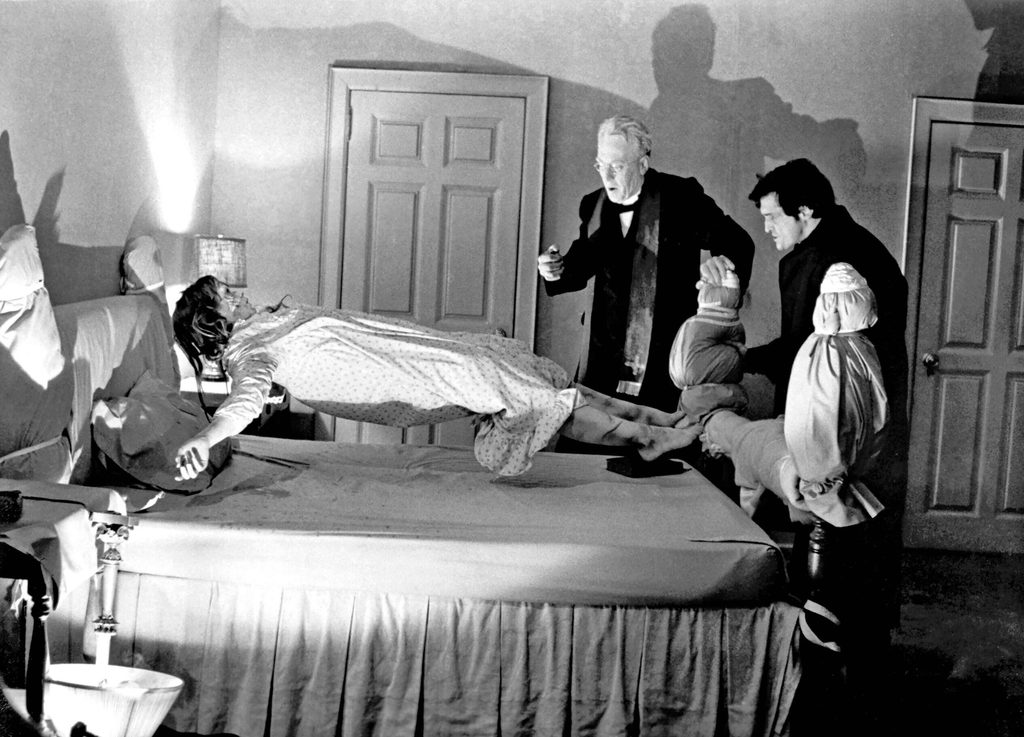
At the heart of The Exorcist, past all the pea soup and radical new approaches to chiropractic alignment, lies a very human story, and at its centre is a very human, deeply flawed hero.
There is an argument to be made that Karras has the most complete character arc in The Exorcist. Chris starts as a loving mother, becomes concerned, has those concerns horrifyingly validated and ends as a loving mother. Regan starts as an innocent child, suffers a demonic interlude and, once Pazuzu has been forcibly evicted, ends as an innocent child again.
But Karras?
Karras has what we writers technically refer to as a fucking awesome arc.
He is built from contradictions: a priest who doubts the existence of God, a psychiatrist brought face to face with something psychiatry cannot explain, a son tormented by guilt over his mother and a man whose vocation demands certainty when he is fresh out of faith.
Merrin knows what he believes and is steadfast in that belief. Chris is certain about what matters to her. Pazuzu, meanwhile, appears extremely secure in his career choices.
Karras is the one stuck somewhere in the middle.
Which makes him perhaps the most human and relatable character in the story.
His guilt over his mother is crucial. Karras spends much of the story believing that he failed someone vulnerable when she needed him most. He couldn’t give her the life or care he wanted to, and her death leaves that failure festering inside him.
Then along comes Regan.
Another vulnerable person.
Another person he might not be able to save.
And another opportunity to fail.
But when the moment comes, Karras doesn’t suddenly rediscover perfect faith. The clouds don’t part. God doesn’t hand him a certificate declaring his theological crisis officially resolved.
“His faith returns as action, not certainty.”
He still doubts.
He still hurts.
He acts anyway.
Karras doesn’t defeat Pazuzu because he suddenly becomes the world’s greatest theologian with a direct line to God. He doesn’t uncover some secret incantation in Aramaic. He doesn’t roll a natural 20 on his exorcism check.
He wins by losing.
By making himself the target.
Suddenly all that guilt, doubt, shame and perceived failure has somewhere to go. The man who believes he failed his own mother absolutely refuses to fail Regan.
This isn’t some action-movie sacrifice. Karras isn’t Bruce Willis staying behind to detonate the nuke and save mankind.
He is a man who spends most of the story wondering whether there really is a God and ends it through an act of profoundly Christian self-sacrifice.
Not because someone finally proves the doctrine to him.
Not because every doubt disappears.
Because when confronted with the damnation of a child, he chooses to put himself in the way.
His faith returns as action, not certainty.
Conclusion
More than fifty years later, we remember the pea soup, the spinning head, the obscenities and the silhouette of a priest standing beneath a streetlamp. They have become part of horror’s furniture, copied, parodied, moved around, and recycled until even people who have never seen The Exorcist know what an exorcism movie is supposed to look like.
But none of that is really why The Exorcist still works.
It works because Chris loves her daughter. Because Regan is worth saving. Because intelligent people exhaust every reasonable explanation before accepting the impossible. And because Damien Karras, riddled with guilt and doubt, ultimately discovers that faith doesn’t require certainty before it demands action.
Pazuzu provides the horror, but the people give that horror weight.
Strip away the pinpoint-accurate projectile vomiting, the profanity and fifty years of cultural baggage, and underneath it all is a remarkably human story about love, fear, doubt and sacrifice.
Turns out there was always more to The Exorcist than pea soup.
Peace, love, Corn syrup

What to read next.
Horror Has a Class Problem

Horror has always known how to spot the rich and the poor before anyone spills a drop of blood. From murderous aristocrats and immaculate penthouses to rusting cars, bad teeth and houses at the end of dirt roads, class is often written into the monster long before the monster acts. But why does wealth get a motive while poverty gets a chainsaw?
The Silence of the Lambs: Book Vs Film
From Hannibal Lecter’s icy stare to Buffalo Bill’s basement of nightmares, The Silence of the Lambs remains one of the most disturbing and influential thrillers ever made. But how closely does the film follow The Silence of the Lambs by Thomas Harris? In this deep dive, Robin B Devlin compares book and film, exploring the biggest similarities, the darkest differences, behind-the-scenes trivia, and the cultural impact of Hannibal Lecter. From deleted subplots to iconic performances by Anthony Hopkins and Jodie Foster, this is a love letter to one of horror’s finest meals.
Evil Dead Old Vs New

Dive into the blood-soaked world of The Evil Dead as we compare the 1981 cult classic with its brutal 2013 remake. From Ash Williams’ iconic battle against Deadites to Mia’s relentless fight for survival, this deep-dive explores what makes each film unforgettable. Is the original’s raw, practical horror better than the remake’s slick, modern brutality? Packed with analysis, nostalgia, and gut-churning moments, this is the ultimate Evil Dead comparison for horror fans old and new. If you love cabin-in-the-woods terror, demonic possession, and chainsaw justice, this one’s for you.