Greetings from the edge,
As I have previously mentioned, I love music. The broom cupboard is always full of some wonderful sound, be it a classic rock album, a musical soundtrack or a little dash of punk. I love it all. It’s a pity, really, that my own attempts to make music end with me producing sounds that would qualify as sonic war crimes under any sane government.
During the pandemic, with an abundance of time and far too much access to online shopping, I got into vinyl in a big way, and although I was never a ‘£900 oxygen-free audio cable’ guy, I did fall down the rabbit hole of genuinely believing that those dinner plate-sized discs sounded better than CDs and absolutely curb-stomped MP3s. But was that belief actually founded in fact, or was I just hopping aboard the hipster bandwagon?
So, I did what every ageing music nerd with access to Google and too much confidence does: I looked into it properly. What I found was surprisingly nuanced. As it turns out, the answer is a lot more complicated than vinyl snobs and Spotify goblins would have you believe.
The Core Question
Do vinyl records objectively sound better than other formats?
From a pure engineering standpoint… not really.
Digital audio, particularly in lossless formats such as FLAC, ALAC or WAV, is remarkably good. Unlike MP3s and other compressed formats that shave off bits of audio data to save space, lossless audio preserves the full original recording. In simple terms, what comes out of your speakers is an almost perfect reproduction of what went in.
That means digital audio is generally:
- cleaner
- truer to the source
- less noisy
- more durable
- capable of a wider dynamic range
In practical terms, a FLAC file doesn’t slowly sandpaper itself to death every time you listen to it. Go ahead and spin your original pressing of Bat Out of Hell for the hundredth time; technically speaking, it will sound ever-so-slightly worse than it did on the first play thanks to microscopic wear on the grooves.
Digital audio also has another unfair advantage: consistency. Your music doesn’t care if the cat sat on the speaker, the room is dusty, or your turntable needle cost less than a Greggs sausage roll. A digital file either plays correctly or it doesn’t.
But, and this is where we take it to the bridge, that’s not the whole story.
Why People Think Vinyl Sounds Better
Vinyl absolutely sounds different, and that difference comes from a strange cocktail of factors. Unlike digital audio, vinyl is an analogue medium physically representing an analogue soundwave. Add in things like harmonic distortion, surface noise, the quirks of individual cartridges and needles, and the subtle inconsistencies that creep in over time, and you end up with a sound that many people describe as “warmer.”
That warmth is not necessarily accuracy. In fact, from a strictly technical standpoint, it is often the opposite.
But humans are funny creatures. We do not always want perfect accuracy; sometimes we want character.
Vinyl sounds pleasantly imperfect.
Like film grain on an old reel of cinema.
Like a paperback held together with sticky tape, coffee stains and prayer.
Like a pub with crooked floorboards and stained carpet instead of a sterile airport lounge.
The flaws become part of the experience. The occasional crackle and pop stops feeling like damage and starts feeling human.
The Real Secret: Ritual
I think the real secret here isn’t the quality of the sound, it’s the quality of the experience.
To play a decent-quality audio file, you press a button and, before you know it, Dusty Springfield is informing you that despite being jaded and cynical, she has nevertheless fallen for the son of a preacher man.
To get that same experience with vinyl, however, you need to select the album, carefully place it on the spindle, lower the needle, and then Dusty can begin recounting her romantic misadventures with Billy Ray.
The point is that streaming music very easily becomes wallpaper.
As I type this, The Only Ones are wailing across the decades through the magic of streaming, insisting that “space travel is in their blood” over what may genuinely be the greatest bassline in punk history, and yet I am not truly listening to the song. I’m writing this post. The music is atmosphere.
And that is perfectly fine.
But vinyl, through the ritual of the process itself, transforms music into an event.
That matters psychologically.
It is why people talk about listening to records instead of having Spotify on while prepping dinner and doomscrolling through the latest signs of civilisation folding in on itself like a dying spider.
Summary
So, what does all this actually mean?
In purely technical terms, records hiss, crackle, and wear down over time, and if you throw your lot in with the “vinyl just sounds better” crowd, you are only a small step away from exclusively listening to Belgian acid jazz on original pressings before eventually disappearing into a fog of £900 audio cables and financial regret.
The point of music is that it is accessible. Everyone should be able to enjoy it, whether that means a lossless FLAC file through a decent pair of headphones or a stereo setup that costs more than a respectable second-hand car.
But enjoyment cannot be distilled into a scientific formula.
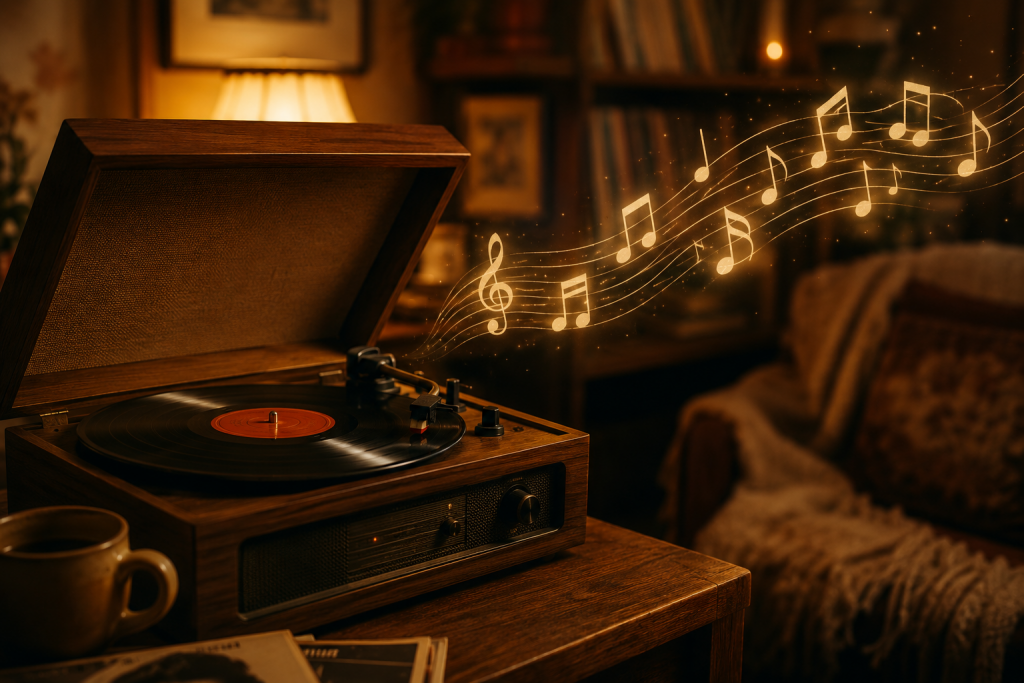
Sometimes you just need to sit in dim light at an ungodly hour while your trusty turntable crackles into life like you are summoning a ghost.
And honestly?
That’s kind of beautiful.
See you in the margins,

Leave a Reply