Greetings from the edge,
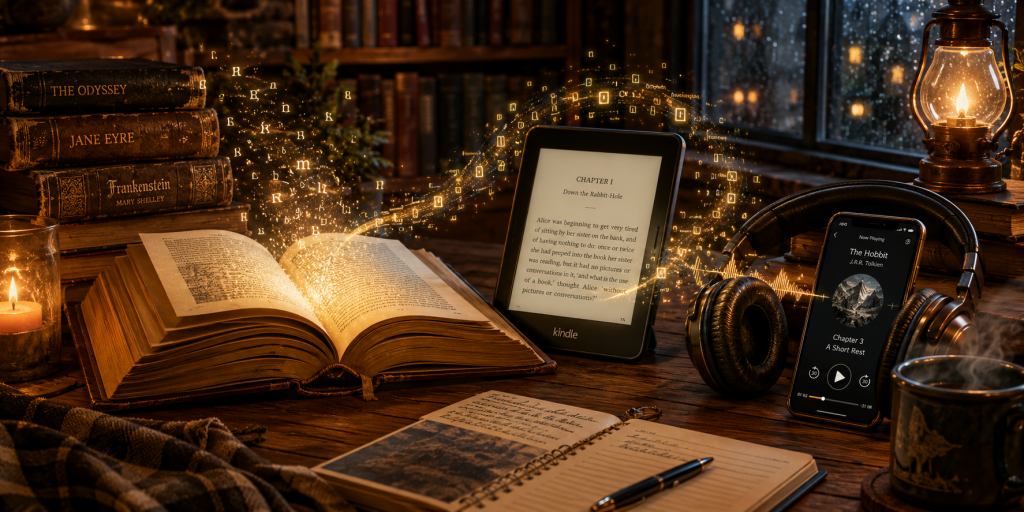
I’m a bibliophile. A die-hard, hardback, leatherbound devotee of the written word. I like books of all shapes and sizes and read across a wide range of genres, although I am yet to venture into family sagas. One day perhaps. When the Kindle first appeared, I carried that sleek little slab around like it was The Hitchhiker’s Guide to the Galaxy and I was Ford Prefect. Naturally, the first thing I downloaded was Douglas Adams’ increasingly inaccurately named trilogy of five.
When Audible arrived, I jumped at the chance to have some of my favourite stories narrated to me while I worked, travelled, or tackled the sort of household chores that require a warm body but absolutely no intellectual investment whatsoever. Suddenly, I could be “reading” while ironing shirts or pretending to understand laundry symbols.
I like books. That’s what I’m saying.
I love the romance of physical books. One of my favourite things at the library is spotting a stranger reading a novel I adore. It feels oddly personal, like the book itself is recommending a human being.
I love the intimacy of a well-narrated audiobook. Listening to Blood Meridian on Audible felt less like consuming a novel and more like sitting beside a campfire while an old cowboy recounted something terrible beneath an endless prairie sky.
I love how absurdly practical and accessible e-readers are. My Kindle effectively turned my backpack into a tiny extradimensional library. Hundreds of books, all quietly waiting behind a single button press like patient little ghosts.
But here’s the thing:
What actually is the best format?
Wood Pulp, Ink, and the Greatest Gift Mankind Was Ever Given
I owe Johannes Gutenberg one hell of a solid. In 1440, he uncorked the bottle and handed humanity movable type printing. Suddenly, books could be mass-produced, knowledge could spread beyond monasteries and nobility, and the common man gained access to ideas that had once been locked away like dragon treasure. Gutenberg is effectively patient zero for bibliophilia.
A good book is not just a passive thing you process with your eyes and a few overworked sections of the brain. A good book is sensory. Ritualistic, even.
There’s the smell of paper. An aroma so beloved that people now buy candles designed to smell like libraries. There are cracked spines worn like battle scars, coffee stains, dog-eared pages, frantic marginalia scribbled in the dead of night, and bookshelves that act as personality maps to the soul of their owner.
Then there are second-hand bookshops, those magnificent archaeological digs where every shelf feels like buried treasure waiting to be unearthed.
An old book is far more than the sum of its parts. It is not merely a few grams of ink pressed into pulped wood. Books are little sarcophagi full of preserved thoughts.
And I’m not talking about those poor souls on TikTok who buy a dozen leatherbound classics purely to construct a “dark academia” backdrop before never reading a single page. I mean a copy of Animal Farm so heavily thumbed it looks like it was written on papyrus. I mean treasured runs of gloriously trashy old paperbacks from the 1960s, yellowed with age and smelling faintly of dust and forgotten attics.
A good book collection is like a second brain that the world can see.
A literal library in your pocket
E-readers like the Onyx International Boox or the “evil empire’s” original Amazon Kindle are, quite frankly, witchcraft.
There is no universally agreed number of books required to qualify as a personal library, but the general consensus hovers around the 1,000 mark. A modest 16GB Kindle, meanwhile, can hold somewhere between 2,800 and 15,000 books depending on file size. That means one tiny black rectangle can potentially contain the equivalent of fifteen respectable personal libraries.
That is absurd.
More absurd still, a fully loaded Kindle technically weighs slightly more than an empty one because information itself has mass. The difference is microscopic, roughly an attogram, but I remain deeply amused by the idea that downloading fantasy novels physically increases the density of an object, however imperceptibly.
E-readers are also astonishingly practical. Adjustable fonts help when your eyesight begins quietly betraying you after the age of thirty. Dyslexia-friendly fonts make reading more accessible. Built-in dictionaries mean you can instantly look up unfamiliar words without pretending you were “totally going to check later.”
And then there is the true danger:
instant book purchasing.
If you finish the first novel in a trilogy at two in the morning, the Kindle does not encourage healthy decisions. It does not suggest sleep, hydration, or moderation. It simply opens a glowing portal directly to the sequel and whispers:
“Go on. Just one more chapter.”
Audiobooks and the “That Doesn’t Count” Crowd
Hot take: audiobooks still count as books. The clue is very much in the title.
There is absolutely a certain kind of magic in reading words directly from a page, in your eyes scanning symbols and your brain transforming them into places, emotions, and people that do not physically exist. When prose is smooth and the story grips you properly, there are few feelings quite like becoming emotionally attached to little black marks on dead trees.
But…
Storytelling predates the written word by thousands of years. Long before paperbacks, hardbacks, or e-readers, human beings sat around fires telling stories into the dark. The spoken word was our first narrative technology. It is how children first encounter stories and how adults still share jokes, memories, gossip, and myths.
And sometimes, when everything aligns perfectly, audiobooks capture lightning in a bottle.
Take What Lies Between Us by John Marrs. The novel itself is already a tense psychological labyrinth packed with enough twists to give you whiplash, but Elizabeth Knowelden’s narration somehow elevates it from excellent to unforgettable.
Audiobooks are performance art.
A good narrator does not simply recite the text like a disinterested babysitter mentally drafting their resignation letter. A talented narrator adds rhythm, tension, humour, vulnerability, and menace. They become part actor, part campfire storyteller.
A funny book becomes funnier.
A heartbreaking book cuts deeper.
And a horror novel can become genuinely unsettling.
Look at The Silence of the Lambs. I own both the paperback and the audiobook, and I can safely say that if you want Hannibal Lecter to sound even more terrifying than he already does on the page, then Frank Muller’s narration is the remedy you are looking for.
Audiobooks also quietly expand the amount of time available for reading. Suddenly, all those strange in-between moments in life become story time: walking the dog, washing up, commuting, painting miniatures, sketching, folding laundry, pretending to understand DIY instructions.
And honestly?
If someone absorbed the story, the themes, the characters, and the ideas, then they experienced the book.
No matter what the gatekeepers say, if words written by another human being made their way into your brain and changed something inside you, then yes:
You read the book.
The Real Secret: Ritual
With a physical book, you get the smell of paper, the soft whisper of turning pages, and the little ritual of moving steadily through a story one page at a time. E-readers offer convenience and inclusive immersion, while the intimacy of a good narrator telling an engaging yarn creates a ritual entirely its own.
But the truth is, it doesn’t really matter whether you read Dracula in a leather-bound first edition with a glass of red wine beside you, on your e-reader during the morning commute, or tucked up in bed listening to an all-star cast bring the story to life.
If you experienced the words written all those years ago, rather than simply skipping straight to the 1992 Bram Stoker’s Dracula movie adaptation, then you read the book.
Stories are older than paper.
Older than ink.
Older than printing presses.
The format changes.
The magic never did.
See you in the margins,
Leave a Reply