

Greetings from the edge,
I make no secret of the fact that I’ve been wrestling with my mental health for a while now. For further reading, see… well, anything I’ve written. At my lowest ebb, a few years ago, I picked up 12 Rules for Life by Jordan Peterson.
I can safely say it changed my life. By the time I finished it, I was a fortnight older and perhaps five minutes wiser.
It didn’t transform me into a paragon of order and personal responsibility. If anything, it turned me into a slightly more sceptical version of myself, one increasingly wary of the ecosystem the book lives in.
Now, to be fair, I’m not claiming Peterson is entirely wrong. Even a stopped clock gets a couple of moments of glory each day. What I am saying is that he packages a mix of banal, trite, anodyne but, occasionally useful advice inside a worldview that quietly smuggles in some very shaky assumptions about hierarchy, gender, and suffering.
So rather than shouting “nonsense” into the void and calling it a day, let’s take the rules one by one and see what actually holds up under a bit of light..
Stand up straight with your shoulders back
WE. ARE. NOT. LOBSTERS.
Confidence matters. Absolutely. Carry yourself like you belong in a room and, more often than not, your brain will eventually get the memo. But reducing human worth to dominance displays borrowed from creatures that urinate out of their faces is, while biologically poetic, scientifically speaking… a bit wobbly.
We’re not just crustaceans with better tailoring. Human success isn’t a posture check, it’s a tangled knot of context, opportunity, luck, and where you started on the board. Standing up straight might help you play the game, but it doesn’t rewrite the rules.
Treat yourself like someone you are responsible for helping
This is, on its own, fairly good advice. If it had been left at that, we could all nod politely and move on.
But Jordan Peterson rarely leaves a simple idea alone. In 12 Rules for Life, it’s framed as though people struggle primarily because they lack discipline, as if the main barrier between suffering and stability is a firmer grip on your own collar.
In reality, a lot of people are wrestling with structural issues, poverty, and poor mental health. For someone deep in that mire, this kind of advice can feel less like guidance and more like being handed an umbrella in the middle of a flood.
Self-help without any awareness of circumstance quickly curdles into condescension. At its worst, it starts to sound suspiciously like, “Have you tried not being depressed?”
Make friends with people who want the best for you
On the face of it, yes, this makes perfect sense. Taken at headline value, it’s the sort of advice no one argues with.
But dig a little deeper, and it starts to imply that struggling people, you know, our actual friends, are liabilities to be trimmed away like we’re carefully cultivating a bonsai tree.
Community isn’t a LinkedIn filter, and friendship isn’t a performance metric. People are messy. They have bad days, bad habits, and the occasional talent for acting like complete jackasses. That doesn’t make them disposable; it makes them human.
Real friendships aren’t built on constant upward trajectories. Sometimes you carry people. Sometimes they carry you. And sometimes you both just sit in the mud together for a bit and call it solidarity.
Compare yourself to who you were yesterday
Another one that sounds bulletproof on first reading. Even some unshaven British smart arse would struggle to object… at least in principle.
In moderation, it’s healthy. Pay attention to your own progress, not someone else’s highlight reel. But taken to its logical extreme, this rule turns life into a never-ending performance review, an ouroboros of self-optimisation where you’re both employee and manager, and neither is ever satisfied.
Growth is good. Obsession with growth is just a treadmill with no off switch.
Sometimes you improve. Sometimes you plateau. Sometimes you backslide a little and eat biscuits instead of becoming your best self. That’s not failure, it’s being a person.
Do not let your children do anything that makes you dislike them
I once legitimately asked God (or the universe, if you prefer) to make me a better man. The very next day, I found out I was going to be a father.
I’ve got things wrong with my son more times than I can count. And while there are moments I don’t always like him, I love him more than anything in this world. I wouldn’t change a single thing about who he is.
His life is just beginning to take shape, and although I’ve tried to pass on my own values, integrity, empathy, the usual toolkit, he’s carving out his own path. Would I have chosen it for him? Not exactly. Is it better than mine? I don’t know. But it’s his. And that matters more than anything.
This rule frames parenting as a kind of reputation management, as though children are PR disasters waiting to happen. They’re not. They’re chaotic, unpredictable little experiments in becoming human.
Guidance beats control. Every time.

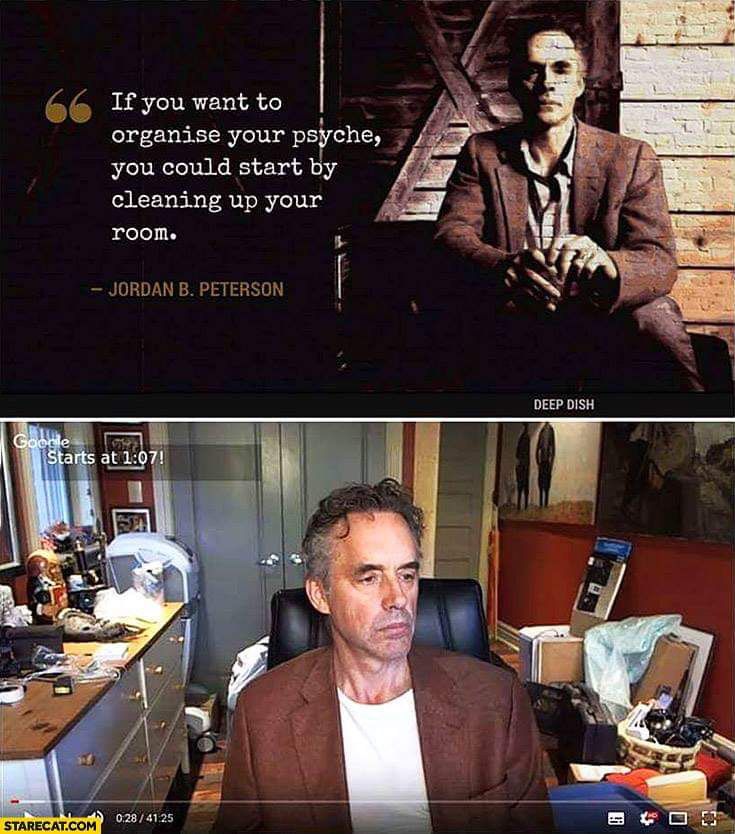
Set your house in perfect order before you criticise the world
This one sounds sensible until you follow it to its logical conclusion, at which point it quietly collapses in on itself.
Taken seriously, it becomes a rhetorical trap: no one is ever allowed to criticise anything, because no one is ever “in perfect order.” And since perfection doesn’t exist outside of motivational posters and very expensive Instagram feeds, the end result is simple: silence.
Personal responsibility and social critique aren’t mutually exclusive. You can have a messy room and still recognise that your roommate keeping a rabid badger in theirs is, in fact, a problem. The state of your sock drawer doesn’t invalidate your ability to notice something is wrong.
At its best, this rule encourages self-reflection. At its worst, it becomes a convenient way to dismiss criticism without engaging with it.
And that’s not wisdom. That’s a conversational escape hatch dressed up as philosophy. One might argue this rule is easier to preach than to live up to.
That’s it for today. Check back tomorrow for the rest of my… gentle critique… of Dr. Jordan Peterson’s 12 Rules for Life. I can’t believe I got through the whole thing without even mentioning that he dresses like a Batman villain and sounds like a mid-tier Muppet.
In all seriousness, though, if you are hurting and you feel that something is missing, reach out to flesh-and-blood people. Don’t let yourself drift into an echo chamber, and remember that nowhere is as quiet, or as free from interruption, as your own soul.
See part 2 here
See you in the margins,

Leave a Reply