Greetings from the edge.
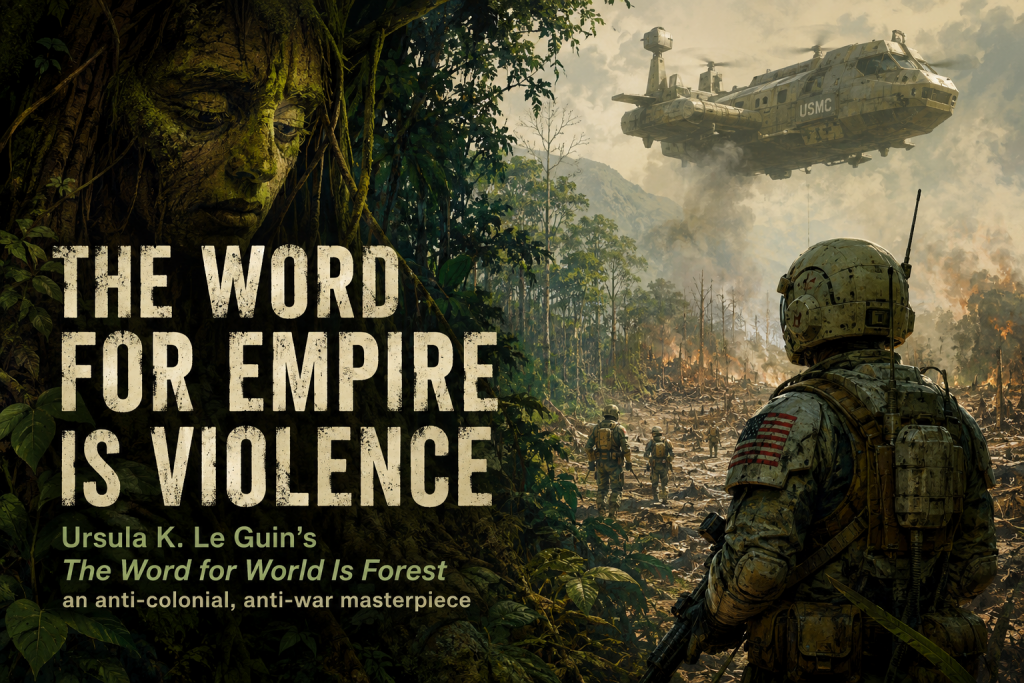
I finished The Word for World Is Forest, and I have to say, it is the most anti-colonial and specifically anti-Vietnam War book I have ever read. It is one of the most openly political things Ursula K. Le Guin ever wrote. Not quite fat enough to qualify as a novel, The Word for World Is Forest is a furious anti-war screed wrapped in ecologically aware science fiction before that was even remotely fashionable.
The parallels to Vietnam are not even wearing a fake moustache. They are standing in the middle of the room with their fingers under their nose speaking in a ridiculous falsetto.
A vastly technologically superior military force invades a heavily forested preindustrial world through overwhelming violence.
• The invaders justify brutality through ‘civilising’ rhetoric and resource extraction.
• The occupiers see the native population as primitive, childlike, or not quite human.
• Guerrilla resistance emerges from people who know the terrain intimately.
• The occupiers become morally degraded by the war itself.
And, naturally, the whole thing revolves around resources the natives possess in abundance, but the invaders desperately lack thanks to their own ravenous consumption. Which does feel rather reminiscent of a few real-world “excursions,” doesn’t it?
In many ways, the setting itself, the forest world of Athshe, is as much a character as Selver or the beastly Captain Don Davidson. It’s not just a pretty skybox for the action to play out in. The forest is culture, spirituality, memory, and identity. The destruction of the land is treated not only as environmental damage, but as a direct metaphysical and psychological act of violence. That maps very cleanly onto critiques of American defoliation campaigns in Vietnam, especially Agent Orange and scorched-earth tactics.
Captain Davidson is essentially imperialism distilled into a raging, armed ego. He embodies a racist, militaristic, patriarchal worldview built on the absolute belief that technological superiority equals moral authority. Le Guin writes him less like a man and more like a walking, pus-filled interplanetary cold sore.
(I’m not especially fond of the bloke, in case that somehow wasn’t clear.)
What makes this tale so exquisitely sharp is that Ursula K. Le Guin doesn’t simply say “war is bad” and leave it at that. She goes for a much deeper cut by interrogating the entire psychological collage that facilitates imperial conquest.
• the diminishment of people into disposable resources
• the assumption that “advanced” cultures are therefore entitled to dominate
• the severing of humanity from nature
• masculinity expressed through domination and conquest
There is also an acidic irony running through the entire novella. The humans arrive believing that because the Athsheans are peaceful, they must also be passive and harmless. What they ultimately learn is that oppression itself teaches violence. The colonisers create the very resistance they fear. That idea sat at the heart of many critiques of the Vietnam War era.
Le Guin acknowledged the connection pretty directly in interviews and essays. The novella was written while the war was still raging in the early 1970s, and she later described it as having been written in anger. You can feel that anger bleeding through the prose. There is far less of the calm anthropological distance found in The Left Hand of Darkness or The Dispossessed. This one has teeth.
It’s fascinating because the book arrives during that period where science fiction stopped merely asking:
“What if we had ray guns on Mars?”
…and started asking:
“What if our own civilisation is the monster?”
Put simply, Ursula K. Le Guin, much like Margaret Atwood, managed to write a story that not only slaps in the era in which it was written, but has somehow become even more relevant with age.
See you in the margins,

Leave a Reply