
When the Dice Say No…
…Make it Interesting
By Robin B. Devlin
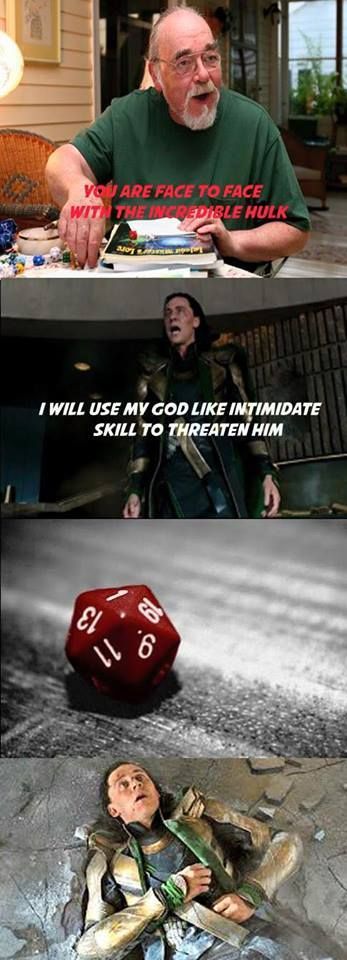
It’s a tale as old as rolling dice and saying whatever insane thing comes into your head.
The rogue painstakingly makes their way along a ten-foot-wide corridor, their companions creeping behind them and nervously fingering their weapons. The dice are on fire. High teen after high teen. They detect no traps.
Then the party reaches an imposing iron-wrought door. Its inches-thick oak planks seem to dare them to progress.
The brave but brash Sir Chargeahead reaches out a gauntleted hand and goes to open it. The rogue stops him with a look, produces their tools, kneels down, checks for traps, finds none, and sets about unlocking the formidable door.
They roll.
Five….poxy, useless, FIVE!
The door remains resolutely locked.
The party stare at the door. The door seems to stare back, as smugly as a door can muster.
“Shall I smite it?” asks Sir Chargeahead.
“I could whack it,” says Chargin the barbarian.
“Shall we eat, then?” asks Baldo the halfling.
That’s the problem. Instead of becoming a fork in the road, failure has become a dry-stone wall.
So let’s see if we can make it a bit more interesting.
Failure Should Move the Game
A hero’s path, in any medium, is seldom straightforward.
If Indiana Jones had noticed the Lao Che logo on the plane in Indiana Jones and the Temple of Doom, he might have realised something was wrong before the plane was abandoned, and we would have been deprived of one of the best escape sequences of the 1980s. No sabotaged flight, no inflatable raft escape, no desperate arrival in India, no plea from the village, no call to adventure, and very possibly no film.
Failure moved the story.
In Alien, if Ripley had successfully convinced the crew of the Nostromo to obey quarantine protocol, Kane would not have been brought back on board, the xenomorph would never have got loose inside the ship, and the whole nightmare would have died outside the airlock as a sensible health-and-safety exercise.
Failure moved the story.
In The Princess Bride, when Vizzini cuts the rope and Westley is left clinging to the Cliffs of Insanity, the scene does not stop. He does not simply fail to climb and fall into the sea like a handsome sack of potatoes in a cool black mask. Instead, Inigo throws him the rope. That act of strange courtesy becomes the beginning of a relationship that matters later, when Westley needs allies most.
Again, failure moved the story.
Time and again, stories show us that failure is not the opposite of narrative. Far from it. Failure is one of the ways narratives happen.
The problem at the table comes when we treat failure as a big stop sign.
The lock doesn’t yield to the rogue’s pick.
The guard is unimpressed by the bard’s attempts at persuasion.
The ranger can’t follow the trail.
The wizard has no idea what the inscription says.
The cleric doesn’t recall the ancient ritual.
And before you know it, the game just sits there, staring at everyone like a stuffed owl.
That is the mistake.
A failed roll should not mean the story has charged face-first into a dungeon wall. It should mean something changes. The party might not get what they wanted, or they might get it in the worst possible way, but the game should still move on.
A failed roll should usually do at least one of the following:
- Reveal information
- Create danger
- Cost a resource
- Change the situation
- Force a choice
- Attract attention
- Escalate pressure
- Complicate success
The important thing is that the roll should leave the table in a different state than before.
If the rogue fails to pick the lock, maybe the door stays shut, but they realise the lock is newer than the door and someone has recently replaced it. That reveals information.
Maybe the lock opens, but a pick snaps inside it. That costs a resource.
Maybe the lock opens, but something on the other side hears the click. That creates danger.
Maybe the lock does not open, but the rogue notices scuff marks suggesting there is another entrance nearby. That changes the situation.
Maybe the party can force the door, but doing so will make enough noise to alert the guards. That forces a choice.
The trick here is not to make failure meaningless. The trick is to make failure productive for the story.
Failure should not always be kind. It should not always be safe. It should absolutely not become a secret way of letting the players win every time the dice betray them.
But it should do something.
Because “nothing happens” is very rarely the most interesting answer.
Failing Forward Is Not Letting Players Win
I had a GM once who was, frankly, a twat.
Nothing pleased him more than setting obstacles in our way and smugly grinning when we failed to overcome them. He essentially locked all of his plot behind a skill paywall and insisted it was up to us to find a way around it.
He would never fudge a roll. He would never let us fail but still learn something useful. He would never adjust the situation based on what we tried. There was the path he had intended us to follow, and if we missed the one roll that opened the gate, then we could apparently all sit in the mud and think about what we had done.
This is astoundingly bad game mastering.
Now, to be clear, failing forward does not mean the players always get what they want. You should not set things up so that no matter how badly they fail, they land on top, wearing sunglasses, holding the treasure, and somehow looking cooler than they did before with a gorgeous Tiefling on their arm.
That is not failure. That is success in a novelty hat.
Failure still needs to bite.
Failing forward does not mean the rogue fails to pick the lock, so the door opens anyway, the guards all fall asleep, the villain develops sudden knee trouble, and a helpful goblin appears with tea and a floor plan.
It means the game does not die of starvation in a desert of sub-par rolls.
If the only way forward is hidden behind a single failed Investigation check, that is not designing a mystery. That is designing a miserable session. What you are essentially doing is balancing your entire adventure on a banana peel, then blaming the players when it slips.
If everything comes down to one failed roll, that sounds like a skill issue on the GM’s part, not the players’.
The question is not, “How do I make sure the players succeed?”
The heart of it is, “What happens now that they failed?”
A botched roll means they do not find the secret door, but they do find fresh scratches on the floor that suggest something large was dragged through here recently.
Maybe they fail to persuade one guard, but the guard’s nervous glance toward the another tells them who is really in charge.
So, they fail to pick the lock, but they learn it has been recently replaced, which means someone is trying to keep something in, not just keep people out.
Maybe they fail to climb the wall quietly, and now they are over the wall, sprawled in a rose bush, bleeding indignantly, while the dogs begin to bark.
None of those outcomes hand the players a clean win.
They still failed.
They are delayed, exposed, embarrassed, injured, poorer, louder, or deeper in trouble than they wanted to be.
But the game is still alive.
That is the difference.
Fall Sideways: The Better Alternative
In his book Failing Forward: Turning Mistakes into Stepping Stones for Success, leadership expert John C. Maxwell said, “Fail early, fail often, but always fail forward.” Since the book landed in 2000, this has become common advice in leadership and self-help circles. Maxwell intended the advice as leadership-speak for using setbacks as lessons, and using failure as a stepping stone on the path to greater success.
It is a very yuppie-coded way of saying, “don’t make the same mistake twice,” and it is very good advice for the boardroom.
But for the tabletop, I prefer fall sideways.
There are times when a failure should not move the players directly to their intended goal. In fact, sometimes it should barge past them, shoving them sideways into adjacent trouble.
Players don’t get a clean result. They don’t get an easy answer. They do not get to saunter neatly through the front door with their immaculate hair and perfectly laundered cloaks billowing in the sweet-smelling wind as heroic music swells and heroic camera angles capture their most flattering sides.
Instead, things get a bit more… spicy.
Let’s say Alonzo the bard completely fails to persuade the guard. I do not just mean natural 1s here, but generally anything that falls below the DC of the roll. Instead of calling the goon squad in to kick their arses, the guard offers to turn a blind eye in exchange for a favour.
This gives your players a choice.
Do they accept the shady deal? What does the guard want? Is the favour small, dangerous, or the sort of favour that will come back to bite them three sessions later?
No prizes for guessing which would be my personal preference.
They might well sneak into the manor with all the stealth of a plumber’s toolbox being thrown down the stairs, but end up mistaken for hired entertainment. They are inside, technically, but now they have to bluff their way through a banquet, avoid or shanghai the actual musicians, and finally work out if any of them can tell one end of a lute from the other without committing what can only be described as musical war crimes.
They botch the roll to track the monster, but they do bumble into where it has been sleeping. They may not have found the beast, but they have found its lair, shed skin, the remains of its last meal, a symbol carved into the stones around its nest, a tiny handmade charm someone has left as an offering, or maybe even its young.
They bork the roll for decoding the inscription carved into a stone altar, but realise that someone tried to destroy the words recently. They still do not know what the ancient words say, but they now know someone was frightened enough by them to take a hammer and chisel to the stone.
They mess up climbing the wall that is in the way, but fall through a grate hidden by detritus and into an old drainage tunnel beneath it. They are not where they meant to get to, but the plot still marches on. Sure, they have a bruised bum, are wet, and are probably ankle-deep in the least romantic water feature this side of the short-lived Salmonella Flume Ride, but they are approaching the problem from a completely new direction.
That is falling sideways.
You don’t give your players a “get out of the oubliette free” card, but they do get to approach the problem from a new angle.
These situations are fuel for the tabletop, and a decent GM will be able to make a fun situation out of almost any of them.
This is an especially useful approach when a simple duff roll would stall the game. If the only result of failing to pick a lock is “you are still outside the room,” then nothing has changed. Your players are left staring doe-eyed at the problem with ever-waning enthusiasm.
But if the failed roll means that they break the lock, that a guard on the other side hears them and opens the door, or that they realise someone else has already tried to access the room, then the scene is alive again.
The trick here is to make the fall sideways feel organically connected to the original desired outcome.
Don’t have the rogue mess up picking a lock only to suddenly discover a dragon jamboree in the very next room, unless that kind of glorious nonsense is the modus operandi for your campaign. Ideally, the complication should grow naturally from the situation.
Failed a lockpick roll? It might reveal past tampering, alert someone nearby, snap the lockpick, fire the trap, or suggest another entrance.
Failed a Persuasion check? They might offend the noble they were trying to sweet-talk, attract the attention of their rival, reveal that the guard is frightened, or force the party to seek leverage in another way.
Failed a Survival check? They could lose the trail, but uncover old tracks, signs of a larger predator, evidence of another party, or proof that the monster is not travelling alone.
They still categorically fail.
They aren’t getting the polished, glossy, heroic, best-case scenario version of the story, but they are still getting a story.
The failure has pushed the game somewhere useful, not to mention interesting. Somewhere awkward. Somewhere dangerous.
They may have wanted a door.
But what they got was a window, a sewer grate, a bribe, a witness, a problem, and the distinct smell of narrative blood in the water.
Something is better than nothing.
That is falling sideways.
Explode Dramatically: When Failure Escalates
There are times when the planets align, the stakes are high, and the dice choose the path of the chaos goblin. In those moments, your players’ failure should be loud.
The spell misfires.
The rope bridge gives way.
The panicked guard shouts.
The cursed idol opens a vivid green eye.
The noble smirks imperiously and yells, “Arrest them.”
The stealth mission ends in a chase scene involving chandeliers, curtains, and at least one person shouting, “This is still stealth!”
Not every failure needs to be greeted with fireworks and a marching band. If every whiffed Stealth check results in alarm bells, vicious dogs, windows exploding, and three platoons of heavily armed bastards busting out of every doorway, then failure doesn’t feel dramatic or even cinematic.
It’s exhausting.
But there are moments when failure needs to do more than change the situation.
Normal failure changes the situation.
Dramatic failure escalates it.
The wizard doesn’t simply whiff at identifying the rune. The rune reads them.
The rogue doesn’t merely fail to disarm the trap. The trap wakes up, splutters out dust, the Saw theme starts playing, and the trap takes the matter personally.
The bard does not just fluff the critical roll to talk down the duke, who is already livid at some terrible faux pas the party have committed. The duke goes very quiet, smiles a twisted smile, and orders the doors locked.
The ranger doesn’t simply lose the trail. They find out, much too late, that the trail was leading them in circles because something has been leading them into a trap.
This is not about punishing the players for rolling badly. That is important. You are not dropping a piano on them because the dice looked at their well-laid plans and chose violence.
You are paying off pressure that already exists.
Dramatic failure works best when the danger has been established, the players know the stakes, and the roll matters. The alarm spell has been mentioned. The bridge was already rotten. The guard was already suspicious. The idol was already humming. The noble was already insulted, cornered, or looking for an excuse.
In other words, the explosion should not come from nowhere.
It should feel like the thing everyone was trying very hard to avoid.
This is especially useful in scenes where tension has been building. A stealth mission can only remain quiet for so long before the murder-hobos in the party start to vibrate. A negotiation with a tyrant, a climb across a bridge held together with spit and paper, an intricate ritual performed under pressure, a parkour-heavy rooftop chase, or an attempt to bluff, sweet-talk, or otherwise deceive the villain’s lieutenant all carry the same question, like a hefty axe:
What happens if this goes wrong?
Sometimes the answer is not “you fail.”
Sometimes the answer is “run.”
That is when the game changes shape.
The infiltration becomes a chase. The chase becomes a skirmish. The skirmish becomes a desperate escape. The negotiation becomes a hostage situation. The ritual becomes a containment problem. The crumbling bridge becomes a falling problem.
And the cursed idol?
That becomes everybody’s problem.
That is good failure.
It does not stop the story. It throws the story through a window, then demands to know what everyone is going to do about all the broken glass.
The trick is to use dramatic failure sparingly. If every failed roll detonates the room, your players will stop taking risks, stop trying interesting and exciting plans, and start approaching every problem with the dead-eyed caution of a man defusing a bomb in a shed full of clowns.
Save the big escalation for moments where it earns its chair.
Use it when the players knew the danger and pushed forward anyway.
Use it when the scene is already balanced on a knife edge.
Use it when a quiet failure would feel dishonest.
Use it when the table needs the moment to turn.
Because sometimes the best thing failure can do is not nudge the game forward, or shove it sideways.
Sometimes failure should kick the door off its hinges, set the curtains on fire, and shout, “Right then, new plan.”
The Cost Menu: Don’t Roll Unless Failure Has Teeth
The golden rule: before your players’ hands touch a die, ask yourself one question: what happens if they fail?
And to be blunt, if the only answer is “not much,” then don’t bother rolling. Just let them do the thing.
Failing forward, falling sideways, and exploding dramatically are all brilliant tools, but none of them work unless the GM knows what failure can actually cost.
Boring failures are the antithesis of fun, dynamic play. The rogue failing to pick a lock and it not affecting anything is a snore-fest. Same thing with the ranger making a cock-up of tracking, losing the trail, and then leaving everyone standing around with no new information, no pressure, and no useful way forward.
It is not always wrong to have a damp squib, but if you leave the players with no change in the situation, no pressure, and no decision to make, you have left your game to die of starvation.
So, you need to be selective about what you roll for.
Remember that by the time they even hit level one, your players will have shown expertise in their fields that sets them apart from the regular peasantry. So don’t make the ranger roll to follow tracks in soft mud that a blind kobold could spot, unless failure means something interesting.
If they are a trained ranger, the tracks are clear, and there isn’t any time pressure, why are you rolling unless something interesting will happen if it all goes pear-shaped?
It is not like there is a realistic chance they will forget how many feet their quarry has, after all.
Let them follow the tracks.
Roll when there is pressure.
Roll when there is danger.
Roll when there is uncertainty.
Roll when failure has teeth.
The Failure Menu
When a roll fails, ask what kind of cost makes sense. Not every cost fits every situation, but this menu gives you something to reach for when the dice land badly and everyone turns to look at you.
- Time: It takes longer than expected.
- Noise: Someone hears.
- Resources: Tools break, spells are spent, rope is lost.
- Position: They are separated, exposed, trapped, delayed, or forced somewhere awkward.
- Information: They misunderstand something, miss context, or reveal something by mistake.
- Reputation: Someone sees, hears, remembers, reports, gossips, or takes offence.
- Danger: A threat advances, wakes, hunts, notices, or prepares.
- Time: It takes longer than expected.
- Noise: Someone hears.
- Resources: Tools break, spells are spent, rope is lost.
- Position: They are separated, exposed, trapped, delayed, or forced somewhere awkward.
- Information: They misunderstand something, miss context, or reveal something by mistake.
- Reputation: Someone sees, hears, remembers, reports, gossips, or takes offence.
- Danger: A threat advances, wakes, hunts, notices, or prepares.
- Choice: They can succeed, but only if they accept a cost.
- Choice: They can succeed, but only if they accept a cost.
Take a simple lockpicking roll. The rogue fails. That does not give you one possible answer. It gives you several.
- Time: The lock opens, but it takes ten minutes.
- Noise: The lock clicks open loudly enough for someone nearby to hear.
- Resources: The pick snaps.
- Danger: The trap arms itself instead of disarming.
- Choice: They can force it, but doing so will alert the guards.
A failed Persuasion check does not always have to mean “they say no.” It might mean the conversation moves somewhere more awkward.
- Reputation: The noble agrees, but everyone in the room saw the party grovel.
- Choice: The guard will help, but wants a favour.
- Information: The guard refuses, but reveals who they are really afraid of.
A failed Survival or tracking check does not have to mean “you lose the trail and everyone has a little sit down until the plot comes back.” It can still change the shape of the journey.
- Time: They find the trail, but lose half a day.
- Danger: They find the monster’s path because something else is following it too.
- Information: They lose the trail, but discover the creature is wounded, nesting, or being herded.
You should always have the cost grow from what the player was trying to achieve in the first place.
If the rogue fails a lockpicking roll, it is much more likely that it costs them their favourite lockpick than it is that they completely forget how tumblers work, or somehow ruin their reputation with every thieves’ guild in a 50-mile radius.
This keeps failure connected and stops it from feeling arbitrary.
Your players should say:
“Crap. Welp, that makes sense.”
Not:
“How in the hell has my failed Athletics roll made the moon god angry?”
The rule of thumb here is that before calling for a roll, you should know what success looks like, know what failure might cost, and make sure both are worth leaving in the hands of the notoriously fickle dice gods.
If failure would be boring, don’t roll.
If failure would change something, roll the bones and see who bleeds.