Taverns, Trouble, and Tiny Kingdoms: Building a Great Starting Settlement
By Robin B. Devlin
A lot of fantasy campaigns start the same way, especially in D&D. The party rocks up to a village or town with dreams of adventure and intrigue, only to find one blacksmith (run by a dwarf, naturally), one pub, a quest giver, and maybe, if they’ve been very good, a temple… all with the personality of dragon spit.
It works. The first time.
By the tenth, it starts to feel like you’re adventuring through a copy-paste error.
At that point, players spend more time fiddling with their character sheets on D&D Beyond than they ever will reading your ten-thousand-year timeline or learning about the lost dynasty of the Moon Elf Empire.
Here’s the uncomfortable truth: your starting town matters more than your world lore.
If you begin with a memorable settlement, the world around it feels memorable. If it’s bland, it doesn’t matter how fascinating your feuding dwarf clans of the northern mountains are. Everything starts to taste like tepid tap water.
A good starting town doesn’t need to be a sprawling metropolis like Waterdeep. It just needs a few strong ideas, a handful of interesting characters, and a couple of problems the players can’t resist poking with a stick.
UPDATE: I have written a blog post with a few D20 tables to get you started here.
Give Your Settlement a Strong Hook
A good hook can carry an entire village on its back.
Think along these lines:
- A coal mining settlement where everyone wears masks to filter out the “bad air”
- A fishing village built into the skeleton of a dead sea monster
- A village where the town guard are semi-sentient golems
- A gnome settlement where everyone keeps bees and brews dangerously good mead
- A poisoned land built on a bog, slowly sinking into it
None of these is complicated. That’s the point.
They are simple, punchy ideas that players can grasp instantly. More importantly, they stick. Players might forget the name of your capital city, but they will absolutely remember “that weird bee village” or “the place built inside a giant ribcage.”
And here’s the good news: nothing says your village has to be standard.
“You are planting a flag. A single, bold idea that makes your players sit up and think: ‘What’s going on here?’”
It’s your world. If you want a woodland settlement that lives in uneasy harmony with wolves, do it. If you want a retirement community for old adventurers swapping war stories over weak ale and stronger regrets, Godspeed, you magnificent lunatic.
There are no wrong answers here. If it’s fun, it’s viable.
At this stage, you are not building a full ecosystem or writing a doctoral thesis on local agriculture. You are planting a flag. A single, bold idea that makes your players sit up, lean forward, and think:
“Alright… what’s going on here?”
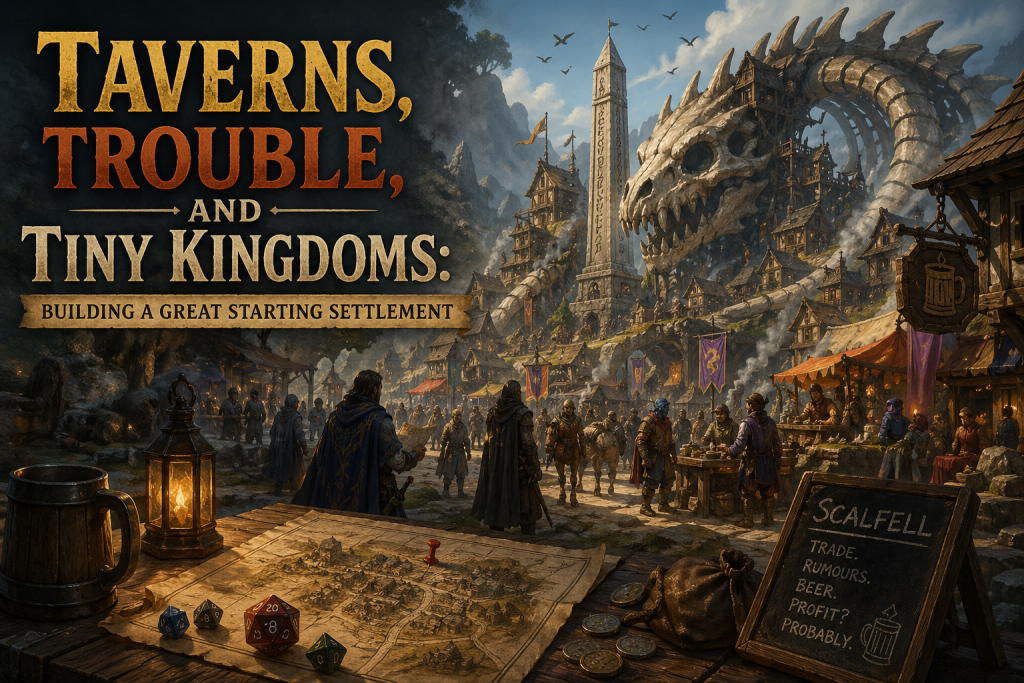
Let’s run with an example: a town built on an ancient dragon graveyard. Since we need something to scribble on the map, we’ll call it Scalefell.
Now, Scalefell should exist for a reason.
What Do People Actually Do There?
Once you’ve got your big idea, it’s time to dig a little deeper into what life actually looks like.
Ask yourself:
- What keeps the place alive?
- What do people eat?
- What do they trade?
- Why has nobody moved away… or why are they leaving in droves?
- What happens if the local industry collapses?
You don’t need to be an urban planner or a medieval historian, but the logic should hold together under a bit of scrutiny. A thriving fishing village with no river, lake, or coastline is going to raise eyebrows for all the wrong reasons.
The local economy shapes everything.
An agricultural village feels different from a mining settlement. A logging camp has a different rhythm from a pilgrimage site. A town built on vineyards will smell like crushed grapes, damp earth, and questionable decisions made after the third cup.
So what about Scalefell?
If it’s built on a dragon graveyard, maybe it has become a trading post for rare materials. Dragonbone, scale fragments, strange minerals warped by ancient magic. Traders pass through from distant lands, chasing profit or power.
That tells us a lot, very quickly.
Scalefell might smell of spice, smoke, and something faintly metallic in the air. The streets hum with unfamiliar accents and clinking coins. Stalls display oddities you won’t find anywhere else. Maybe the local tavern cook is from a far-off land across the sea, serving dishes no one in the region can pronounce properly, let alone cook.
And just like that, the world starts to feel bigger.
You are not just building a village. You are building a crossroads, a pressure point, a place where lives intersect and stories collide.
Add a Few Memorable NPCs
There is an unwritten rule in every TTRPG:
Your players will ask the name of the one NPC you did not prepare.
You’ve done it yourself. Don’t lie.
This is why a short list of spare names is worth its weight in gold. When the party corners “Man Standing Near a Barrel,” you want something better than uh… Steve?
That said, you do not need to build a full backstory for every villager. In fact, please don’t. That road leads to madness.
All you really need are three to five memorable NPCs prepared ahead of time. The rest can be improvised, as long as you jot the name down somewhere before it vanishes into the void between sessions.
What matters more than names is role.
Think in terms of what the NPC does in the story:
- The authority figure
- The gossip
- The friendly face
- The suspicious one
- The person with a problem
Then give them a twist.
“Give every important NPC one thing players can notice, one thing they can question, and one thing they can exploit.”
Try not to let their job be their personality. Drumm might be a blacksmith, but “blacksmith” is just how he pays the bills. It is not the sum total of his existence.
“Give every important NPC one thing players can notice, one thing they can question, and one thing they can exploit.”
What makes NPCs stick is a quirk, a contradiction, or a hook you can hang roleplay on.
Maybe the mayor of an elven village is an ancient treant who takes ten minutes to answer a yes-or-no question. Maybe the local healer refuses to treat anyone who hasn’t apologised to the forest first. Maybe the town guard captain is terrified of the dark and overcompensates with bluster.
A few quick examples:
- A beekeeper who treats their hives like beloved children
- A village elder whose story changes every time you ask it
- A blacksmith with a very real, very recent criminal past
- A priest convinced the geese are spying for someone
- A tavern owner who never, ever leaves the building
A strong personality will beat a ten-page biography every single time. You are not writing their memoir. You are giving your players something to bounce off.
Let’s drop a few into Scalefell:
- A priest of the Light with a criminal past, trying very hard to be better
- The ageing captain of the guard who once hunted that priest and has not forgiven him. a failed paladin, now in uniform, quietly resentful of anyone who still carries divine favour
- A tavern barman who communicates exclusively in cackles and somehow remains perfectly understood
And just like that, you have tension. History. Awkward conversations waiting to happen.
You do not need a cast of thousands.
You need a handful of people your players won’t forget.
Give the Settlement Problems
Now that you’ve got a vivid setting, a strong hook, and a handful of colourful, questionable individuals, it’s time to give the place something it is very bad at dealing with.
Problems.
If everything is fine, the players have no reason to care. At best, they will admire your village like a painting. At worst, they will leave it behind without a second thought.
What you want are problems that look small… until someone starts asking the wrong questions.
Good starting troubles might include:
- Livestock disappearing
- Bandits working the nearby roads
- Strange lights in the woods at night
- Missing children
- Crops failing without explanation
- Local monster attacks
- A feud between important families
- A cursed well nobody will drink from
- A mayor with something to hide
- An abandoned house everyone avoids
None of these need to be world-ending threats. In fact, they shouldn’t be.
The trick is that small problems rarely stay small.
A few missing sheep might lead to a cave system full of hungry trolls. The trolls might be working for something smarter. That “something” might turn out to be a goblin cult digging where they absolutely should not be digging.
“Symptom → Cause → Bigger Cause → Oh no.”
And before you know it, your simple village problem has teeth, a history, and a very strong opinion about the continued existence of the party.
Think of it as escalation:
Symptom → Cause → Bigger Cause → Oh no.
Start with something the villagers can describe in a sentence. Let the players peel it back layer by layer until they realise they are no longer dealing with missing livestock… but something far older, far stranger, and very interested in being left alone.
Because nothing says “welcome to the campaign” quite like discovering the local problem is wearing someone else’s face like a poorly fitted helmet.
Let’s say Scalefell’s big problem is simple: the beer delivery has gone missing. This gives us all kinds of potential from pissed-up goblins to puritan priests who are trying to keep the sinful liquor away from the lips of the villagers.
Add One or Two Points of Interest
Think of points of interest like seasoning. A pinch brings the whole dish to life. Tip the whole jar in, and you’ve got chaos in a bowl.
One or two is enough.
These are the places your players will drift back to. The spots they’ll argue about. The ones that quietly whisper, “there’s more going on here…” even when nothing immediately kicks off.
A good point of interest should feel plausible, but just a little… off. Like it belongs, but only just.
It should also pull double duty: a hook for future adventures, or a convincing red herring to keep your players deliciously paranoid.
A few examples:
- A shrine to an ancient or forgotten god, still receiving fresh offerings
- A tavern run by something… unusual
- A cemetery haunted by a benevolent (but very chatty) spirit
- A cave that whispers names, though no one agrees on whose
- A ruined manor house that is always deathly cold, even in summer
- A market square where you can buy almost anything… for the right price
- A local landmark wrapped in a story no two villagers tell the same way
This is the part where you can let your imagination wander a little.
All those strange half-ideas that don’t quite fit anywhere else? This is where they live. Tucked into corners, waiting for curious players to start asking questions they probably shouldn’t.
The best locations feel like they’ve got stories clinging to them like cobwebs. Not all of those stories need answers. In fact, some are better left dangling, gently swaying, daring someone to reach out and tug the thread.
And if you’re feeling clever, seed the road ahead. A passing mention of a neighbouring town’s “miraculous healing springs” can be just enough to send your party packing in that direction next session.
For Scalefell, as well as the dragon graveyard on which the town is built, we could give them an ancient obelisk covered in writings that defy conventional (or arcane) translation.
Rumours Make Everything Feel Alive
Rumours do an enormous amount of heavy lifting.
You can scatter a few narrative seeds and see which ones your players latch onto. More importantly, they make a place feel lived in. If the party walks into a tavern and hears whispers that the mayor is having an illicit affair with a tiefling bard, or that Farmer Joel is seeing redcaps again… then the settlement starts to feel like it exists beyond the players’ immediate orbit.
It has secrets. It has gossip. It has a life of its own.
One of the easiest ways to use rumours is to prep a small random table before the session. You don’t need much. A simple d6 will do the job nicely.
Something like this:
d6 Rumours Table
- The village wise woman is seen visiting the mayor’s mansion every full moon.
- The landlord of the local inn is besotted with a mysterious dancer who arrived a few days ago.
- The king has been replaced with a doppelganger. (No one agrees on when.)
- An army is amassing far to the north, though no one can say who it belongs to.
- The current trouble in town is punishment for the local priest’s sins.
- The farmhands are up to… something. No one is quite sure what.
Not all of these need to be true. In fact, it’s better if some of them aren’t.
Rumours can be:
- True
- False
- Exaggerated
- Misunderstood
- Or dangerously close to the truth
Even nonsense adds texture. It makes the world feel bigger than the map, and it gives your players something to latch onto when they start asking, “What’s going on around here?”
And once they pick one?
Congratulations. That’s now a plot.
Do Not Overbuild
This is all you need to make a village or town sing.
Whether your settlement is a tiny hamlet or a sprawling city, the ingredients are the same. You just change the quantities.
You do not need fifty fully statted NPCs with twenty-page genealogies.
You do not need a manifesto for the town council.
You do not need to write an in-world sermon for the priest’s weekly service.
And you definitely do not need a fully mapped sewer system that no player will ever set foot in.
Just know it exists. If the party decides to go spelunking, you can deal with it then.
The goal is not to build every brick.
The goal is to create the illusion that the rest of the village exists just out of sight. Like stage scenery in a theatre made of mud, smoke, and goblin tax evasion.
Closing Thought
Where you start an adventure matters.
You don’t have to have been roleplaying long to have seen enough “generic village near a forest” to swear off the bucolic life entirely.
Your first settlement is the handshake you offer your players.
“Make it weird. Make it useful. Make it feel alive.”
No one remembers “village with pub #513.”
But they will remember the place with a treant as mayor.
They will remember the pirate cove that worships a wyvern.
They will remember the village where the bees were treated like minor nobility.
Make it weird.
Make it useful.
Make it feel alive.