
The Least Cursed Diamond in the World
By
Robin B. Devlin
A billion years ago, or thereabouts, there wasn’t much happening on the surface of the Earth; we didn’t have nice, easy-to-recognise continents, and all of the land was grouped together in a massive supercontinent called Rodinia – not Pangea, that came later. There were no animals, no plants, only single-celled organisms, the descendants of which would, eventually, become the protozoa, plants, algae, slime moulds, animals and fungi we know today.
There was water, vast oceans swimming with cyanobacteria, that had raised the oxygen levels to around 2%, nowhere near enough for complex life – the current level of oxygen in the atmosphere is around 21% – but conditions were starting to improve. Deep under the tumultuous surface of what would go on to become India, primal forces were at work.
At around 100 miles below the surface, with billions of tons of rock on top of it at temperatures of up to 1,300°C at pressures of up to 60 Kilobars – some 50,000 times atmospheric pressure – carbon was crystallising. One chunk of carbon in particular was very, very special. It contained trace amounts of boron; this element gave the crystallised carbon, a diamond, a distinctive blue colour. We would come to know this particular chunk of carbon, aeons later, as The Hope Diamond.
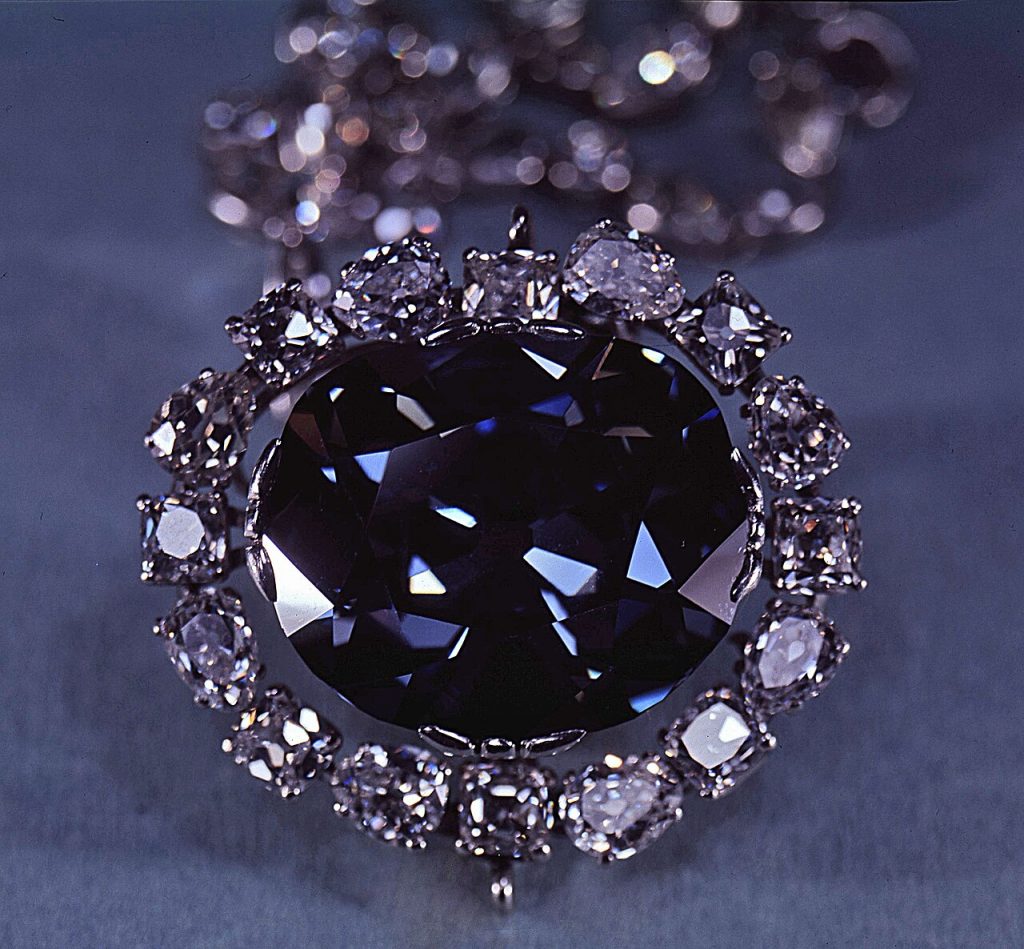
First, let me dispel a myth: Diamonds are not made of coal. Coal is a fossil fuel, the millions of years old remnants of vast forests and plant life that break down over time into a carbon-rich material. Diamonds were formed billions of years ago and were never, in any way, organic. This particular diamond was massive, 112 carats, and would slowly work its way to the surface by molten lamproite and kimberlite, essentially magma tubes that funnelled the gem closer to the surface. Only maybe one in two hundred pipes yields diamonds; this particular one was uncovered in the Kollur mine in India in 1653. India was the only place where diamonds had ever been found up until this point; later discoveries in South Africa and Brazil would end this monopoly.
At the time that this massive gemstone was harvested out of the ground, the tradition in India was that gemstones should not be polished or cut. Diamonds were considered to have magical properties, protecting the holder from everything from lightning strikes to insanity; the bigger the stone, the better the protection it offered. The Sanskrit word for a diamond is vajra, and vajrayudham was the name given to the thunderbolt weapon used by the goddess Indra. Uncut diamonds were often used in the eyes of Hindu Murti (idols). This particular stone would go on to be linked to insanity, bankruptcy, suicide and murder, it would become what we call today The Hope Diamond.
The truth of the curse is, sadly, very pedestrian. It was a pastiche stitched together and embellished by the French jeweller Pierre Cartier in 1910 to add mystique to the valuable stone and to make it more alluring to a prospective buyer, Evalyn Walsh Mclean. Cartier wove together different threads from spurious newspaper reports and even lifted plot points from an 1868 novel, Moonstone, to make the stone more desirable to his nouveau riche client. In Cartier’s salacious tale, the gem was prised from the eye socket of an idol in a long-lost temple, the thief sold the gem for a pittance and was torn to pieces by rabid dogs. From there, the gem travelled halfway around the world to France, where it was gifted to the royal family. King Louis XIV died of gangrene, and all but one of his (legitimate) children died very young. Nicholas Fouquet, who worked for King Louis XIV, is said to have worn the gem proudly at various events until the king soured on him and sent him to be imprisoned in the fortress of Pignerol.
The gem continued spreading its malevolent influence until it fell into the ill-fated hands of King Louis XVI and Marie Antoinette, where it became a favourite bauble of the king. It did not end well for the king and his bride, as they met their end at Madame Guillotine. Marie-Louise, Princess de Lamballe, who was a friend of Marie Antoinette, and who she allowed to wear the gem to a party, met a very unsavoury end at the hands of a mob, her death coming days before that of Marie Antoinette herself. It fell to a jeweller to recut what had been known as The French Blue up until then.
Wilhelm Fals survived the curse, but his son stole the precious stone and was driven to madness and suicide. Likewise, with its new owner, Simon Maoncharides, a wealthy Greek businessman, died in a car accident along with his wife and child. The cursed stone did not rest, Abdul Hamid was a Turkish sultan, known during his reign as “Abdul the Damned” who owned the diamond in the early 1900s.
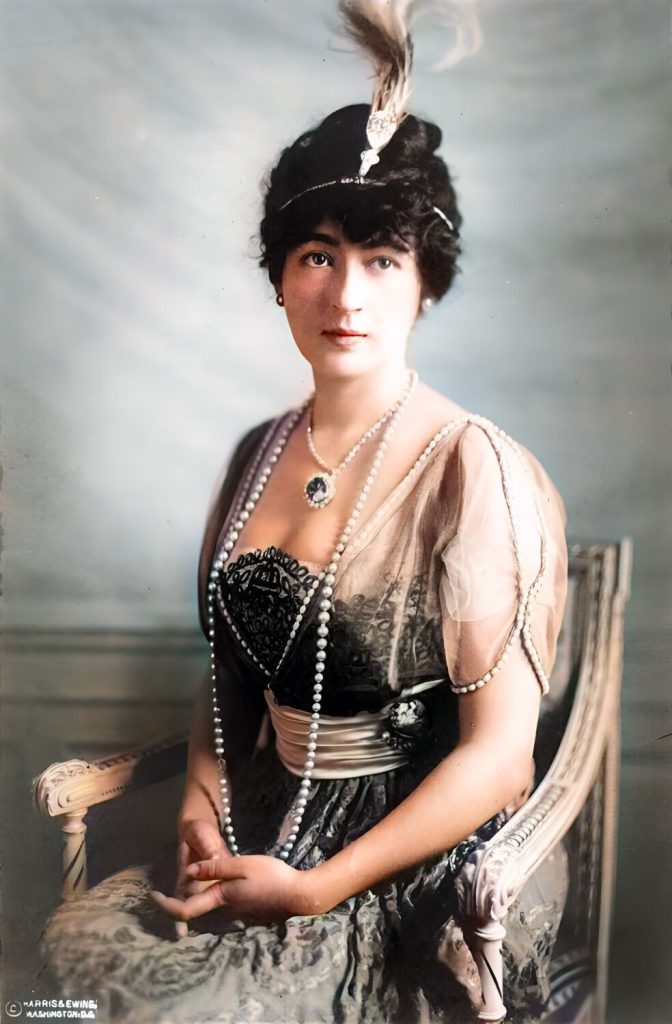
The unfortunate Turk’s reign was marked by rebellions and military defeats. The gem, along with other valuable stones, found itself in the collection of Henry Philip Hope, from whom it has taken its current name. Hope died in 1839; the stone stayed in the family until 1901. From these poor, unfortunate souls, the stone fell through history and into the hands of Evalyn Walsh Mclean, socialite, wealthy heiress and new owner of history’s most dangerous piece of carbon. Clearly, Mrs Mclean was not put off by Cartier’s tale of woe; she bought the gem and added to its legend.
In reality, there was so much embellishment that picking out the nuggets of truth became harder to extract. For example, Jean Baptiste Tavernier, the first recorded owner of the stone, died at the ripe old age of 84 during the 17th century; this was quite an age. Tavernier sold our large blue stone to King Louis XIV in 1668. King Louis was known as the Sun King and loved light in all of its forms, The king loved chandeliers, mirrors and the use of light in architecture, diamonds being an extension of this. The stone was catalogued under the name “The Blue Diamond of the Crown” or, more succinctly, the French Blue.
After the revolution, the crown jewels were passed over to the government and the French Blue was stolen during a period of chaos and looting that took place in September 1792.
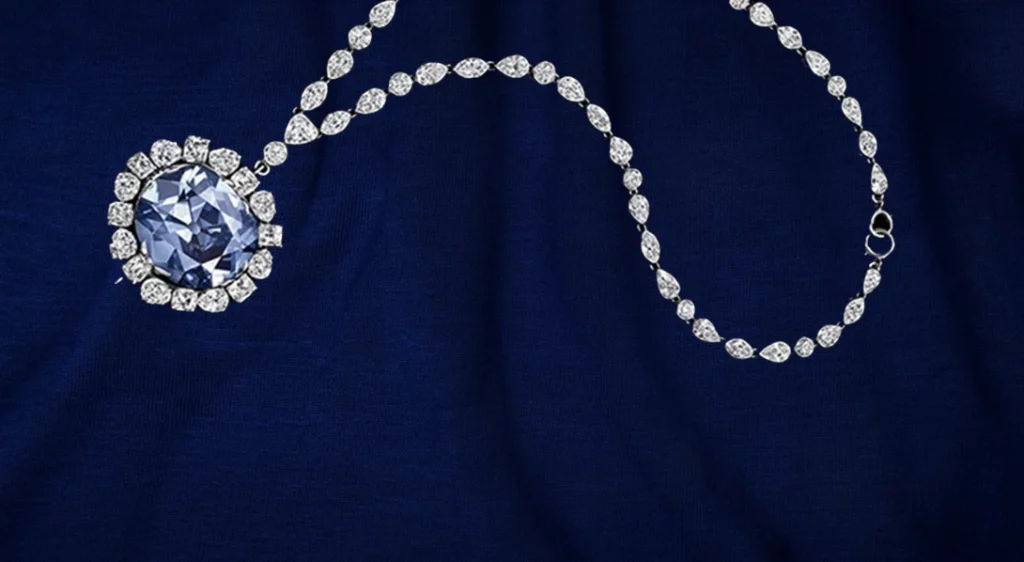
A deep blue diamond surfaced in 1812, a little cut down by now, in the possession of Daniel Eliason, a London diamond merchant. A lot of evidence points to the English crown having acquired the French Blue.
At the time of his death, King George IV’s debts were huge; in 1830, the diamond was likely sold off through private channels.
The diamond surfaces again in 1839 in the catalogue of Henry Philip Hope, for whom the jewel takes its new name. There are some gaps, we don’t know for sure where he got it or how much he paid for it. After he died in 1839, the diamond passed to his nephew after lengthy court wranglings and from there to the nephew’s grandson, Lord Francis Hope.
Lord Francis Hope was granted permission from his sisters, with whom he co-owned the gem, to sell the stone to raise funds to settle his extensive debts. It was moved through a London dealer to Joseph Frankels and Sons in New York, where it stayed for a few years until it was sold off to C. H. Rosenau, and like a hot potato, was resold to our clever story writer, Pierre Cartier in 1909.
Mrs McLean adored her new stone; she would wear it to many events and even had it set into a collar for her beloved Great Dane. She wore this massive historic diamond as a decoration in gowns, swimsuits, or even just doing some gardening.
She sometimes made a party game of hiding the gem and recruiting her guests to find the precious stone. She kept the stone until her death in 1947.
Mrs McLean‘s jewellery collection was vast and breathtaking, among the treasures that were sold to Harry Winston from her collection, also held The Star of the East (94.8 carats), The Star of the South (15 carats) and a 31-carat diamond that history came to know as the McLean diamond. The Hope Diamond was displayed at many charitable events, including the Court of Jewels exhibition.
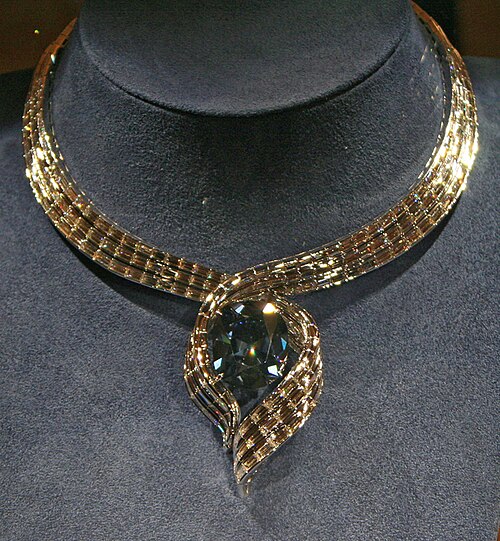
On November 10th, 1958, the Hope Diamond was donated to the Smithsonian Institution, where this beautiful blue stone now sits in pride of place as a premier attraction. The Hope Diamond has been studied by the world’s foremost experts on gemmology and has been categorised as an 11b diamond – a category that makes up only 0.1% of diamonds, which means there are almost no nitrogen impurities.
The diamond phosphoresces a deep red, the effect lasting for several seconds after exposure to short-wave ultraviolet light, giving it an almost supernatural appearance. An analysis in 1988 using a very sensitive colourimeter showed that there is a very slight violet component to the deep blue hue of the gem that is imperceivable to the human eye.
The diamond is estimated to be worth $350 million, making it one of the three most expensive stones in history, closely behind the priceless Kohinoor diamond and the $400 million Cullinan Diamond
RBD