
Not So Random After All
Designing Encounters That Feel Organic and Engaging
By
Robin B. Devlin
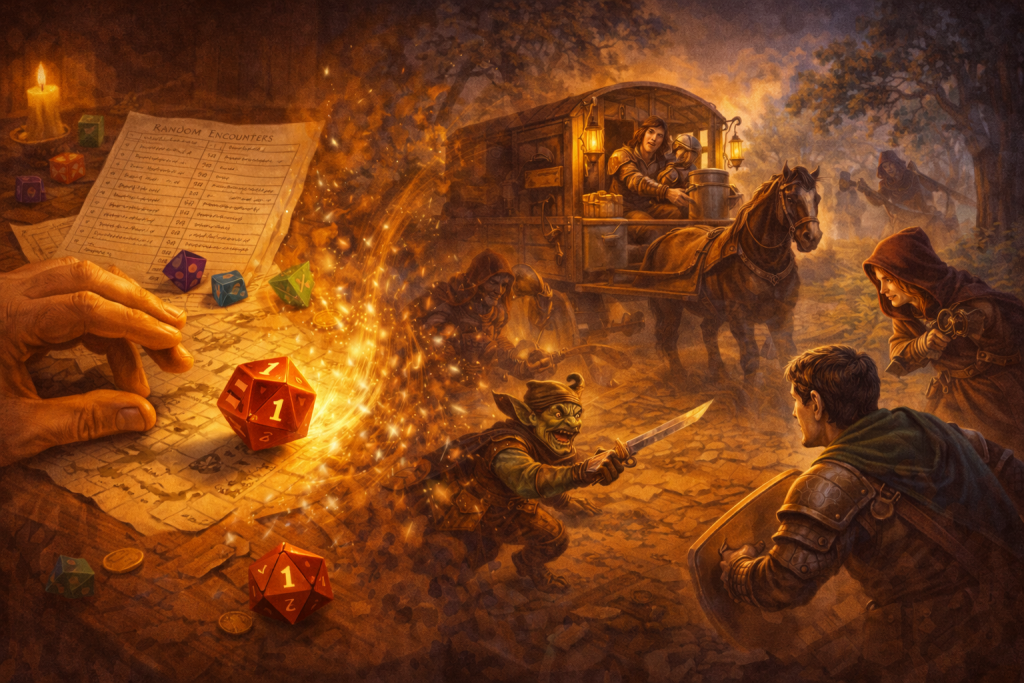
If there is one feature of RPGs, going back to first edition D&D, that is unfairly maligned, it is the humble random encounter. A brief survey of Reddit reveals many threads with a consensus that random encounters suck.
The fact is that if you are rolling up a dozen goblins that mindlessly charge the players, then of course they suck! As with every other aspect of role-playing games, you get out what you put in.
There are a few things you can do to make random encounters more dynamic and gel better with the rest of your adventure. They can add flavour to an otherwise dull journey, they can pad out a session when you have had no time to prep, and they can, if used properly, make your world feel like a living, breathing place.
Random encounters can elevate your game. I once had an entire serial-killer subplot arise from a random encounter with a seller of ‘exotic’ leather goods.
With a bit of imagination, you can elevate even the humblest random pack of Kobolds to an encounter your party will remember forever.
So here are 10 ideas for elevating your random encounters.
Always weave part of a narrative into them.
Always make it feel like the encounter is part of a narrative. It doesn’t have to be the ‘A story’, but what if the orc war-band they encounter are veteran soldiers returning from the front line? That could tie in with the previous night’s encounter with a group of escaped Kobolds who were prisoners of war.
What I like to do is plan a few random encounters ahead of time; that way, you can get a feel for them and tie them in. So, the dead bodies they find on day one of travel can have been slain by the mercenary they meet on day two, who is being chased down by the posse they meet on day three.
Incorporate the player’s backstories.
The most powerful way to make players care about a random encounter is to tie it into their backstory; by that, I don’t necessarily mean what they did before the game. Still, maybe you have a rogue in the party who made an enemy of a rival guild a few sessions ago. You roll up some random undead. Well, what if you made it a thunderstorm for dramatic effect and had the undead be the remains of some of the guild that the party dispatched before?
Or maybe the merchant they meet by the roadside is selling jewellery; one piece looks familiar to the party’s orphaned paladin…
Give the players choices, not just fights.
Sometimes, it’s fun to crack some heads, but it does not always have to be like that. What if the troll you roll up is actually just there to collect a nominal toll for using the road or the bridge they are trying to cross? That way, you can have the virtuous character try to talk the rogue out of trying any ‘funny business’.
Pretty much every encounter should have more than one way around it, from clever problem-solving to just roleplaying the hell out of it, bribery also works.
Add Dynamic Consequences.
Time to apply and adapt Newton’s third law: every action has an equal and opposite reaction. If you slaughter a goblin war-band in one session, they will send out scouts in another, or maybe a larger force will attack the nearest village in retaliation.
The players could find an item that ties into a quest from long ago that they had almost forgotten about, or maybe something that will come in useful for future quests.
Allies and enemies can be made (think of the ‘Boblin the Goblin’ meme). Whatever it is that you decide to do, have the consequences of how they handle their encounters be apparent, maybe not immediately so, but always have something happen in response to the actions your players take.
Vary the encounter types.
Mix things up a bit, not every random encounter has to be an opportunity for roleplay, sometimes violence can be fun, cathartic, even; that’s why you have first-person shooters and not first-person negotiators, that said if their travelling from town to town becomes a non-stop cavalcade of trail by combat, that itself can become tedious.
Give your players a few chances to scratch their itchy sword hands, sure, but also don’t forget about puzzles or moral dilemmas and of course, roleplay opportunities.
Remember, variety is not only the spice of life but also a much-needed ingredient in your TTRPGs.
Introduce Unpredictable Environmental Factors.
Sometimes, when diplomacy has failed, or the party get ambushed, combat is inevitable. It does not have to be boring; however, we can make the environment itself a player in the combat. What if the events took place in a massive rainstorm or a forest fire? A crumbling tower or a collapsing cavern?
Remember, you are the DM, you can do anything you like; so, if the rules for fighting in a disintegrating tower don’t exist, or if they do and you just don’t like them, then write your own.
Use NPCs to Create Emotional Investment.
It’s always a good idea to try to engage with your players through the NPCs when your players encounter them. It is worth noting here that you can never tell what characters will resonate with your players. You can spend hours making an intricate and nuanced character, and he will get passed over every time in favour of ‘Schubert the goblin shoemaker’. This is frustrating, but run with it. However, the NPC develops, they should have their own personalities and goals, their own motives and their own problems.
If they decide to put all their loyalty eggs in the random guy you came up with off the cuff, with the silly name, run with it. Just have half a dozen NPCs worked out ahead of time, and use one of these personalities instead.
Make the Encounter Dynamic and Evolving.
Avoid static encounters at all costs. If your party has had their armoured backsides handed to them on a plate and you roll up a ‘non-magical potion seller’, then consider being a bit more flexible. Like, maybe, he has some healing potions… for a fee.
Also, it’s important that you go in flexible, like maybe the inept bandits that hold up the party are underprepared, and you expect the players to cut through them like a hot knife, but… what if the paladin challenges the leader to single combat? Or does the rogue decide to try to con the bandits? What if the wizard casts ‘charm person’? You need to roll with whatever your players throw at you; it will give them the absolute freedom to do anything they care to, and you will be rewarded for your flexibility by making your game feel much more massive.
Create Opportunities for Character Growth.
Far from just being XP farms, random encounters are really good moments for character growth. For example, they could encounter a beggar by the roadside. Simple enough; however, if you have a player who is playing through a redemption arc, it could be a perfect moment to see how far they have come, far from the big cities.
You can also use random moments like these to truly challenge the characters’ values, strengths, and weaknesses. It will always lead to good roleplay moments and deeper character development, making your game more immersive and meaningful.
Reward creativity and problem-solving.
Always reward things like thinking creatively; this could be the unconventional use of a spell, clever dialogue, or a makeshift tool. The reward could be something as simple as a little on-the-spot XP bump, a narrative reward or even an item.
I have a standing house rule that if someone can make me literally laugh out loud from something their character says or does in-game and in character or come up with some insane/genius idea that I hadn’t even considered, then they get an XP bump.
You, as the DM, are a facilitator, not only telling a story but also providing a framework for the players to have a good time, sometimes this can come from a carefully crafted murder mystery in a brooding gothic castle, or from a tense battle against a necromancer and their undead horde… but sometimes it can come from a goblin called Boblin, selling fake healing potions at the side of the road.
Embrace the random and roll up some encounters. With these ten tips in mind, you can’t go wrong.